Prishtina, 6 October 2026
Faleminderit Valbona!
Dear Andi, certainly we’re not boring, of course we are interesting, yet we’re doing our best not to become too interesting! And so far, so good!
Honourable Lars Castellucci, Federal Government Commissioner for Human Rights Policy and Humanitarian Assistance,
Dear Chief Negotiators with the EU, Predrag Zenović and Jeton Zulfaj, from Montenegro and Kosova,
Your Excellencies, Ambassadors and members of the diplomatic corps,
Dear Andi Dobrushi, Director of Open Society Foundations – Western Balkans,
Dear representatives of civil society and think tanks,
Ladies and gentlemen,
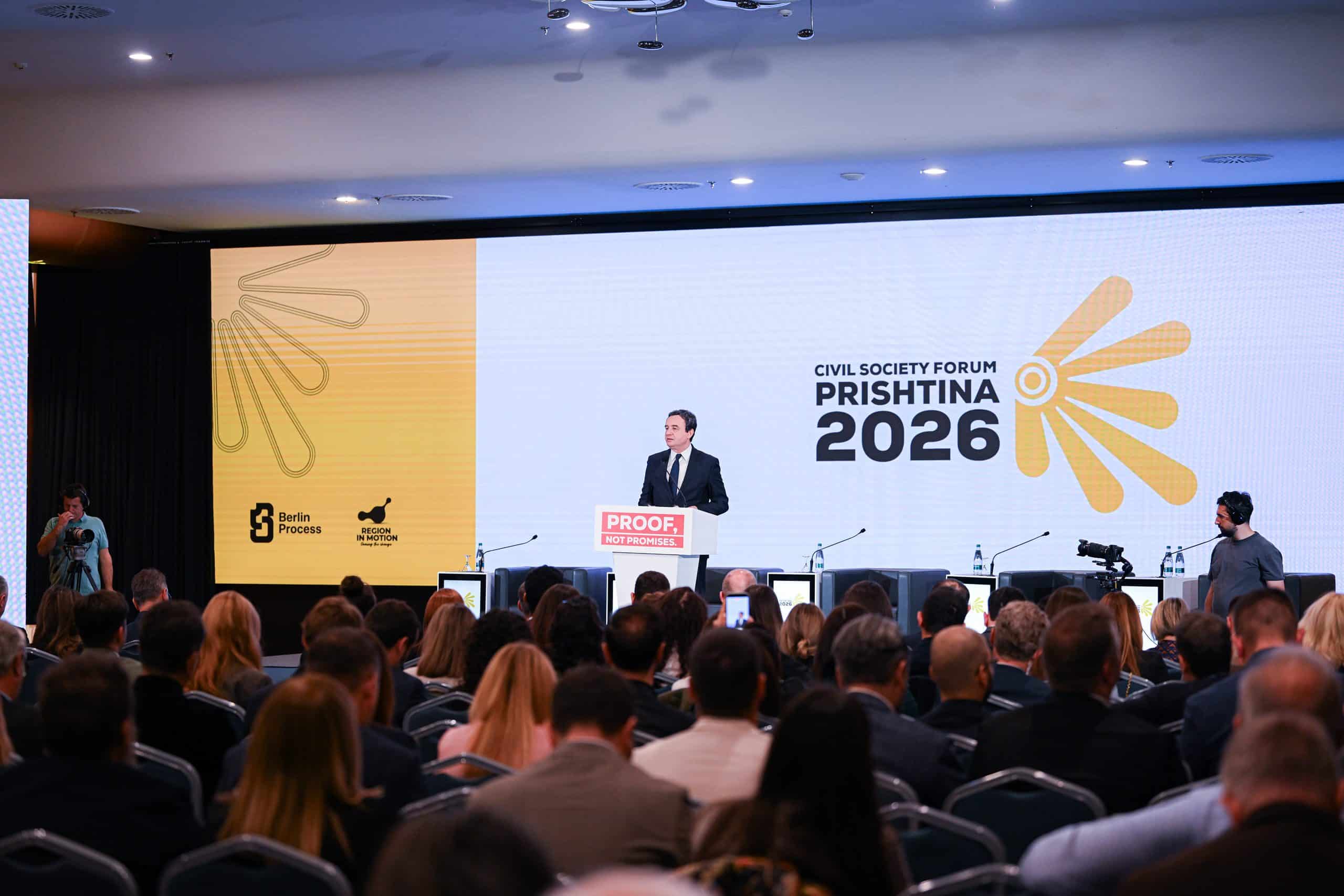
We are happy to be hosting this year’s Civil Society and Think Tank Forum of the Berlin Process, which we have organised together with Open Society Foundations Western Balkans. It is the first time the Forum is held in Kosova, so let me welcome you all to Prishtina, our friends and colleagues from across the region.
A few days ago, Germany marked the Day of German Unity. Its reunification came less than a year after the fall of the Berlin Wall in November 1989, ending four decades in which Germany had been split between two political systems. Democracy prevailed over autocracy, and after 1990, the tranquility and prosperity that Western Europe had been building for decades began to reach much of Central and Eastern Europe too. The Western Balkans, instead, went through almost a decade of wars, set in motion by the repression in Kosova, and ending only with our liberation in 1999.
For the rest of Europe, large-scale war returned only later, with Russia’s aggression against Ukraine. Today, the struggle between democracies and autocracies is fought every day, on many fronts.
This context has given EU enlargement a new urgency, for Europe and for our region. There is a mantra that also holds true: the European Union only becomes Europe by integrating the Western Balkans.
That was not the prevailing view in 2014, when the Berlin Process was born: Russia had just annexed Crimea, and yet enlargement was on hold. Germany stepped in and brought the six of us to the same table, as equals. From that table came the Common Regional Market, built on EU rules and standards rooted in EU values, and what I like to call a double dividend: we reform once and benefit twice, first in the region and later in the EU Single Market. For us, regional cooperation also rests on good and European neighbourly relations, which are only possible when neighbours uphold these values. Often, the blockages in our region come precisely from this: a mismatch in values.
Nonetheless, we chose to lead by example, and that begins with democracy. At a time when more and more countries are sliding towards autocracy, Kosova has become one of the strongest democracies in the Western Balkans and beyond, strengthening the rule of law, fighting corruption and protecting fundamental freedoms. The World Justice Project ranks Kosova first in the region on open government, which measures how open and accessible institutions are to citizens. But open government only works when people make use of it, and in Kosova, our vibrant civil society does so. We are an electoral democracy, with free, fair and competitive elections, and if anything, we have had too many of them lately.
We have also delivered on the Common Regional Market. We ratified all five mobility agreements and the CEFTA protocols on trade facilitation, services and dispute settlement, joined the European register for quality in higher education, introduced electronic identity systems, and brought our busiest border crossings into the Green Lanes. On freedom of movement, Kosova acted first: citizens of Bosnia and Herzegovina can already enter Kosova with their ID cards, while Bosnia and Herzegovina has yet to ratify the agreement. And we have contributed to fairness in regional institutions: in 2024, Kosova replaced UNMIK in CEFTA, and last year, as chair, we unblocked decisions pending for years.
Still, by now, our region should have had a full cycle of mobility, so that our citizens can travel, study, work and retire anywhere in the Western Balkans. In 2022, we agreed to recognise each other’s diplomas, yet four years later our young Europeans are still waiting for their degrees to be recognised. We should have also agreed that those who work in another country of the region can get a work permit more easily, and keep their pensions and social rights when they move.
Those who are ready must be able to move forward. The region cannot keep waiting for those who do not want to move at all.
After twelve years, it is only natural to think about how the Berlin Process can be reinvigorated, and minority rights are one area where it could do more. Almost every community in our region is a majority in one country and a minority in another. When a community has rights on one side of the border and loses them on the other, that asymmetry is an injustice which raises tensions. That is why minority rights should have a place of their own in the Berlin Process, with common standards for the region, from guaranteed representation in institutions to the use of language, education in the mother tongue, and the revitalisation of their culture and traditions. Kosova is ready to contribute to this work.
On issues like these, many of you have worked together across the region for years, often more closely than our governments have, and today, your work is needed more than ever against disinformation. Those who want to weaken confidence in democratic values know that people don’t have to believe their lies; it is enough to raise so many doubts that people no longer know what to believe. Where they sow doubt, you bring facts, through journalism and critical thinking, fact-checking and research, and in doing so, you defend the very values they try to weaken: human dignity, freedom, equality and solidarity. In building a more open and connected region on these values, you will always find a partner in Kosova.
And this brings me to our European path. This December will mark four years since Kosova applied for membership of the European Union, and in these years we have reformed and made undeniable progress. Our economy has grown by more than four per cent a year and unemployment has fallen from 26 to 10 per cent. We are fully aligned with the European Union’s Common Foreign and Security Policy, including every sanction against Russia for its aggression against Ukraine. The Commission’s latest report found no backsliding in any area, and support for EU membership is among the highest in the region. Yet despite all this, Kosova remains the only country in the Western Balkans without candidate status. This Forum’s slogan is “Proof, Not Promises”, and it would be only right, and just, if the next time this Forum meets, no country that has given the “proof” is left outside the accession process.
I look forward to your recommendations, which you will take to the leaders in Podgorica, and which we will take seriously.
Thank you very much!