
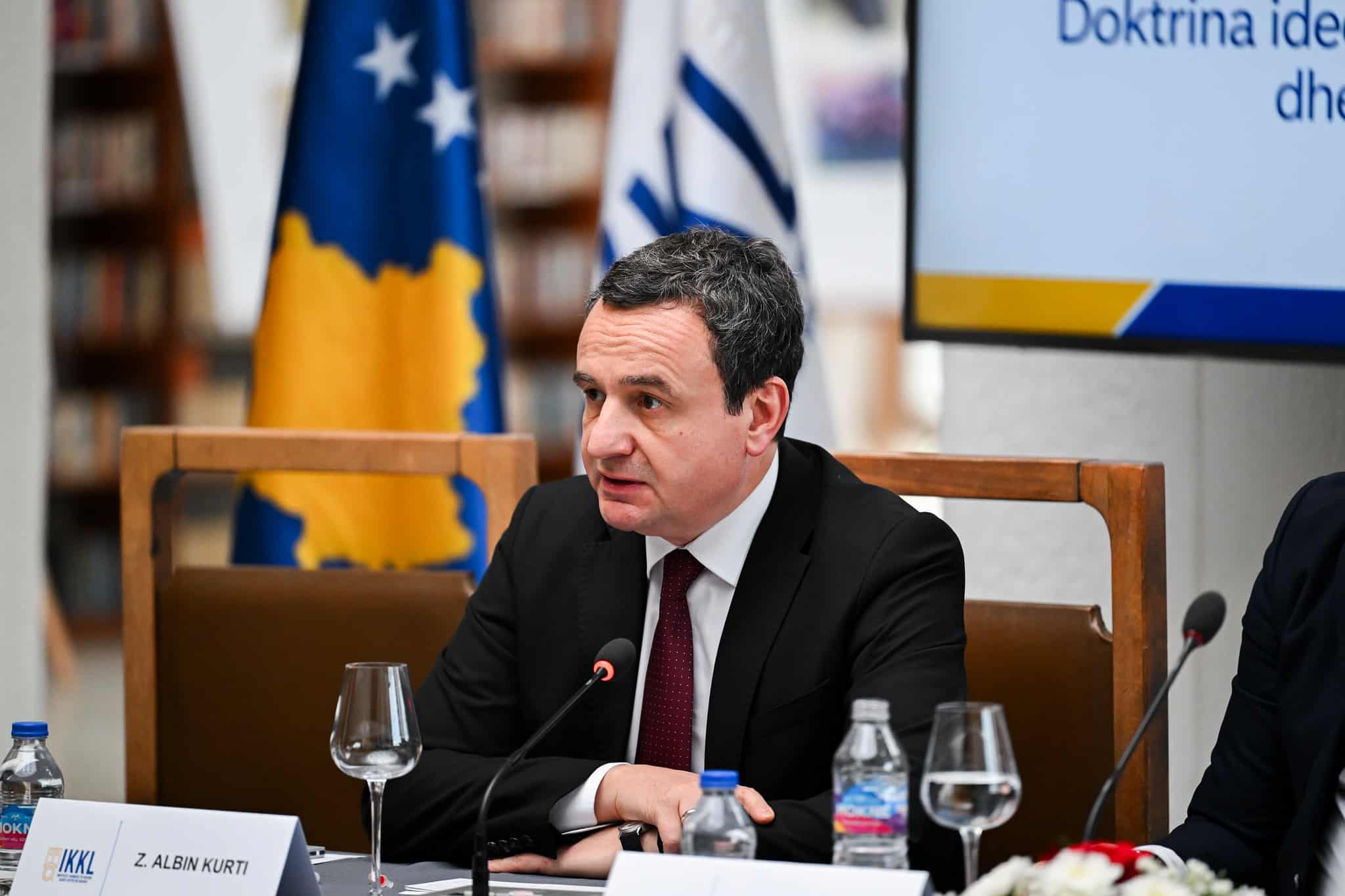
Prishtina, 4 September 2026
Honourable Mr. Atdhe Hetemi, Executive Director of the Institute of Crimes Committed During the War,
Honourable Mr. Arben Hajrullahu, Rector of the University of Prishtina,
Honourable Ms. Teuta Shala-Peli, Director of the Institute of History “Ali Hadri”,
Honourable Ms. Mrika Limani, Research Associate at the Institute of History “Ali Hadri”,
Honourable Professors Sylë Uksini and Arbër Hadri,
Honourable Mr. Edmond Hajrizi, Founder of UBT,
Honourable representatives of the Institute of Crimes Committed During the War in Kosovo and the Institute of History “Ali Hadri”,
Distinguished academics, professors and researchers,
Honourable attendees,
Honourable Professor Afrim Krasniqi, Professor Muhamedin Kullashi,
Ladies and gentlemen,
Forty years after the publication of the Memorandum of the Serbian Academy of Sciences and Arts, it remains important to study the circumstances in which it was drafted, the ideas it articulated and the impact it had on Serbia’s political and social discourse in the years that followed. The Memorandum emerged during a period of profound political, economic and social crisis in the former Yugoslavia. Within this crisis, it articulated an interpretation of the position of Serbs in the former federation, strongly grounded in a narrative of victimisation. Kosovo occupied a special place in this interpretation and, at that time, this discourse was rapidly adopted by political actors and became part of the language through which the increasingly extensive interventions of the Serbian state in the constitutional and legal order of the former Yugoslavia were justified.
This is also why the Memorandum continues to demand the attention of historians, political scientists and researchers. Its importance is connected to the relationship between scientific and social knowledge, intellectual authority and political power. Ideas produced or legitimised within institutions with academic authority acquire particular weight when they enter political language and are used to determine who is a victim, who is a threat and who has a historical right over territory, the state or institutions.
Kosovo’s experience makes this issue particularly concrete. At the end of the 1980s and during the 1990s, the narrative that Serbs in Kosovo were under threat in Kosovo became an important part of political mobilisation in Serbia. This was followed by the suppression of Kosovo’s autonomy, the mass removal of Albanians from public institutions and economic enterprises, systematic discrimination, state repression and, later, war. The path from ideology to violence is complex. Nevertheless, the history of the former Yugoslavia shows that the production of narratives, the construction of discourses, their legitimisation by public and academic authorities and their adoption by those in power can create the political and moral climate in which discrimination is normalised and violence becomes acceptable as a political tool.
This also raises the question of the responsibility of the public intellectual and the academic institution. Academic authority carries public responsibility. Academies, universities and research institutes enjoy society’s trust because critical thought and research, verification of facts and independence from the interests of those in power are expected of them. When this authority is used to give a scientific character to ethnic prejudices or political claims, the consequences can go far beyond academic debate.
For this reason, it is important that the Memorandum of the Serbian Academy of Sciences and Arts, known by the acronym SANU, and the role of the Serbian intellectual elites of that time continue to be studied through documents and credible sources, using scientific methodology. Historical responsibility requires accuracy. It requires identifying the ideas, policies, institutions and individuals who formulated, promoted and implemented them. Kosovo has particular reasons for doing this work.
The consequences of the policies of the 1990s are part of our recent memory and our lived experiences. They are found in documents and archives, in survivors’ testimonies, in victims’ families, among persons who are still missing and in many of the issues that our institutions continue to deal with to this day. Documenting crimes, preserving evidence and studying the processes that led to them are both state and academic responsibilities. Memory grounded in facts serves historical truth, institutional justice and younger generations who did not experience that period.
The Institute of Crimes Committed During the War in Kosovo the Institute of History “Ali Hadri” play an important role in this regard. Through documentation, research and academic debate, our institutions lay the groundwork for Kosovo’s history to be examined through sources and evidence and for the knowledge produced to be accessible to researchers, institutions and the public.
The concept of this roundtable envisages documenting and analysing the role of intellectuals and the academy in inciting wars, critically addressing historical narratives and strengthening collective memory. This work is also valuable for the future, through the inclusion of memory in public policies and education, as well as through the strengthening of regional and international cooperation in the service of peace, security and prosperity.
Forty years provide sufficient distance to see many things more clearly, but the consequences remain present. In Kosovo, they remain part of people’s lives and of the work of institutions. Today’s discussion, therefore, has particular value. The researchers gathered here will address the Memorandum from different perspectives, place it in the historical context of the time and examine the links between academic discourse, hegemonic nationalism and the aggressive policy that led to the wars of the 1990s in the former Yugoslavia.
Democratic societies need institutions that study the past with professionalism and intellectuals who maintain their independence. They need open archives, preserved documents and academic debate in which argument is grounded in facts.
Honourable attendees,
Perhaps it is even more important that roundtables such as this one be held precisely in Serbia. But there is a major paradox with our northern neighbour. The lifeless body of the criminal Ratko Mladić, convicted of genocide and war crimes, is being received with high state honours by Milošević’s former minister, now President of Serbia, Aleksandar Vučić.
Aleksandar Vučić, the protagonist of the hunting of people in besieged Sarajevo, Bosnia, now known as the “Sarajevo Safari”, is receiving with high state honours the perpetrator of the crime in Bosnia, Ratko Mladić, now deceased, having died in prison in The Hague. Vučić is the same person who, among other things, said that for one Serb killed, 100 Bosniak Muslims would be killed, only one week after the Srebrenica Massacre.
This is also a clear example of the way in which the figure of one of those chiefly responsible for the gravest war crimes in Bosnia is glorified in Serbia. When a society publicly honours a person convicted of genocide, it is difficult to speak of confronting the past, remorse or distancing itself from the policy that produced those crimes.
For Kosovo, this is directly linked to the way we will pass history on to future generations. The more complete our documentation and scholarly work is today, the less room there will be tomorrow for denial, distortion and relativisation of what happened.
In Europe, I do not believe there is a second case, that is, there is no other people like the Albanians for whom so many plans and projects have been drawn up, even put down on paper, for their ethnic cleansing, for their expulsion and deportation from the indigenous lands where they were formed and have historically lived. All the more so because these projects were drafted by state structures and institutions as well as by Serbian state officials, from the mid-19th century, when Serbia was still in the early stages of its state-building, through the period of the Kingdom of Serbs, Croats and Slovenes, later the Kingdom of Yugoslavia, as well as during the period of the Yugoslav Federation, when Serbia was the dominant republic. And despite all this, here we are. Although entire segments of these projects have been implemented to a greater or lesser extent, from the expulsions of Albanians from the Sanjak of Niš, through the Balkan Wars and the expulsions to Turkey, all the way to the ethnic cleansing and genocide of 1999, we have managed to survive and to build our common political home with development in every sphere, the independent state: the Republic of Kosovo.
On this 40th anniversary of the SANU Memorandum, this is the responsibility that falls to us: to document accurately, to study seriously, to remember with dignity and to defend the truth with facts.
Thank you for the organisation, the invitation and your attention!