
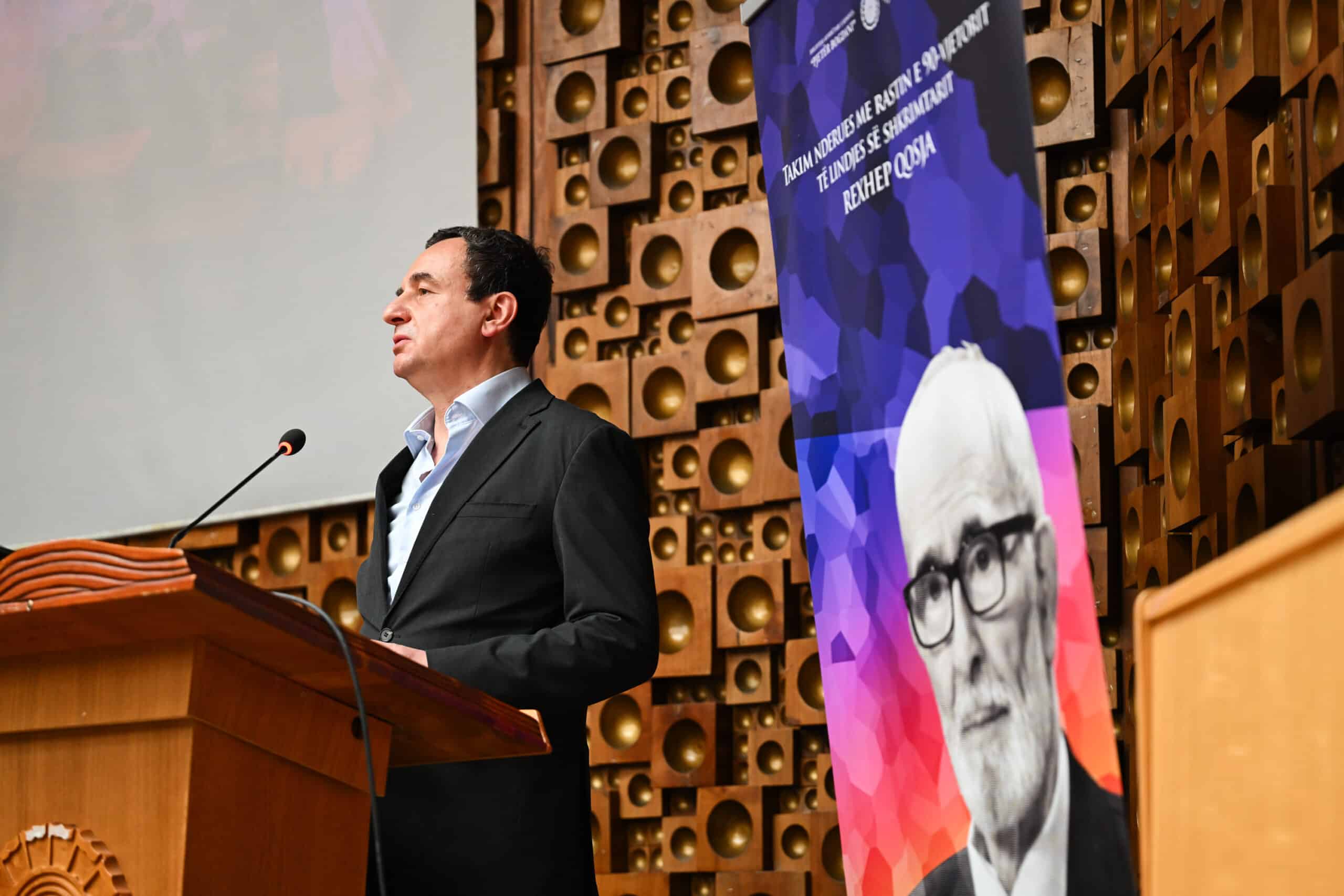
Prishtina, 25 June 2026
Honourable Professor Ag Apolloni,
Honourable Qosja family,
Honourable professors and academics, students,
Honourable colleagues from the Acting Government and from the Assembly, soon in office,
Honourable Ambassadors accredited to the Republic of Kosovo from Albania and Montenegro,
Honourable Director of the National Library, Ms. Blerina Gaxha Rogova,
Dear friends, colleagues and collaborators,
Ladies and gentlemen,
A young man from Vuthaj who comes to Prishtina and, for more than half a century, builds a cultural monument, that will remain a national Albanian testament for all time. This was, and will forever remain, Professor Rexhep Qosja.
He passed away on 23 April this year, in the ninetieth year of his life. From these nine decades, if we begin with his first work, “Episode Letrare”, published in 1967, it is evident that he worked continuously for nearly 60 years as a literary critic, literary historian, novelist, playwright, publicist and professor.
To fully appreciate the true stature of a personality of Professor Qosja’s calibre, one would need to imagine for a moment what Albanian literature, politics, journalism, and cultural and artistic thought in general, and Albanian culture in Kosovo in particular, would have looked like without his remarkably multifaceted figure. This culture would not merely be poorer; it would have lacked one of the pillars of the Albanian cultural pantheon of the twentieth and twenty-first centuries, one of the clearest, bravest, and most profound voices in Albanian cultural and political though. But, at the same time, we would also have been without an immeasurable constellation of intellectuals, researchers, professors and students who drew inspiration from him.
Therefore, just as his contribution is of such magnitude that it cannot be measured, neither can we measure the long succession of those who came after him, and who came because of him.
As a keen observer and thoughtful analyst of events and social phenomena, Professor Qosja came to the conclusion that a nation’s identity does not rest solely on the state or on politics, but above all on its culture, language, literature, and historical memory. In his view, culture should never be regarded as a mere embellishment of national life. Culture is not an ornament; it is a prerequisite for a nation’s very existence. It is what makes our existence possible. For this reason, he called upon intellectuals to take an active role in improving the existing situation. Such a goal, he believed, could be achieved only through hard work and unwavering dedication. Professor Qosja demonstrated this in the most compelling way through the example of his own life and work.
Moreover, he was not a scholar who confined himself to the narrow boundaries of his academic discipline, but an intellectual who extended his engagement into many fields beyond literature. He did so not out of a desire to participate in every public debate, but because the circumstances of the time and the needs of his people, who lived under oppression, demanded it.
Professor Qosja believed that the moral responsibility of an intellectual was never to remain silent in the face of injustice, for the true worth of an intellectual was measured not by the titles he held, but by the truths he had the courage to speak, even when they were not easily accepted, whether by those in power or by the public opinion of the time.
To illustrate this through Professor Qosja’s own example, it is enough to recall that during the 1980s, his polemical writings against the proponents of Greater Serbian policy could not be published in Kosovo’s newspapers and journals. Nevertheless, he found a way to ensure that his voice—and, through it, the voice of the Albanian people—would be heard beyond Kosovo, by publishing his polemical essays in newspapers and journals in Zagreb and Ljubljana.
Professor Qosja emphasized that no nation can build its future by forgetting its own history. Historical memory was not a retreat into the past, but a prerequisite for moving forward. For this reason, he remained one of the foremost bearers of “Porosia e Madhe”, the idea that the Albanian National Renaissance thinkers entrusted to future generations as a national legacy.
He viewed the Albanian nation as a historical and cultural whole, regardless of the political divisions that had been imposed upon it throughout history. In his view, a nation united by a shared culture was a united nation, capable of withstanding any other form of division.
In whatever field he worked, Professor Qosja committed himself with all his being to reach as far as possible. He remains one of the most distinguished scholars in the history of literature, one of the most important writers in literary fiction, one of the most powerful voices in journalism, and one of the most courageous intellectuals in political thought.
Above all, he left us a lesson that runs through all his work: historical time does not wait. Nations that fail to make use of it are left behind by it. For this reason, for more than half a century, Rexhep Qosja worked with extraordinary dedication to place national culture in the service of the Albanian future.
Today, as we celebrate and commemorate the 90th anniversary of his birth, we can say that he left us not only books, studies, novels, and ideas. He left us an entire body of work that continues to live and act even after him. And as long as there are readers of his work, scholars of his thought, and Albanians who seek to better understand themselves and their time, Rexhep Qosja will continue to live on as one of the most representative figures of Albanian culture of the 20th and 21st centuries. In this sense, it is fitting to also say: Happy birthday, Professor Qosja!
Thank you!