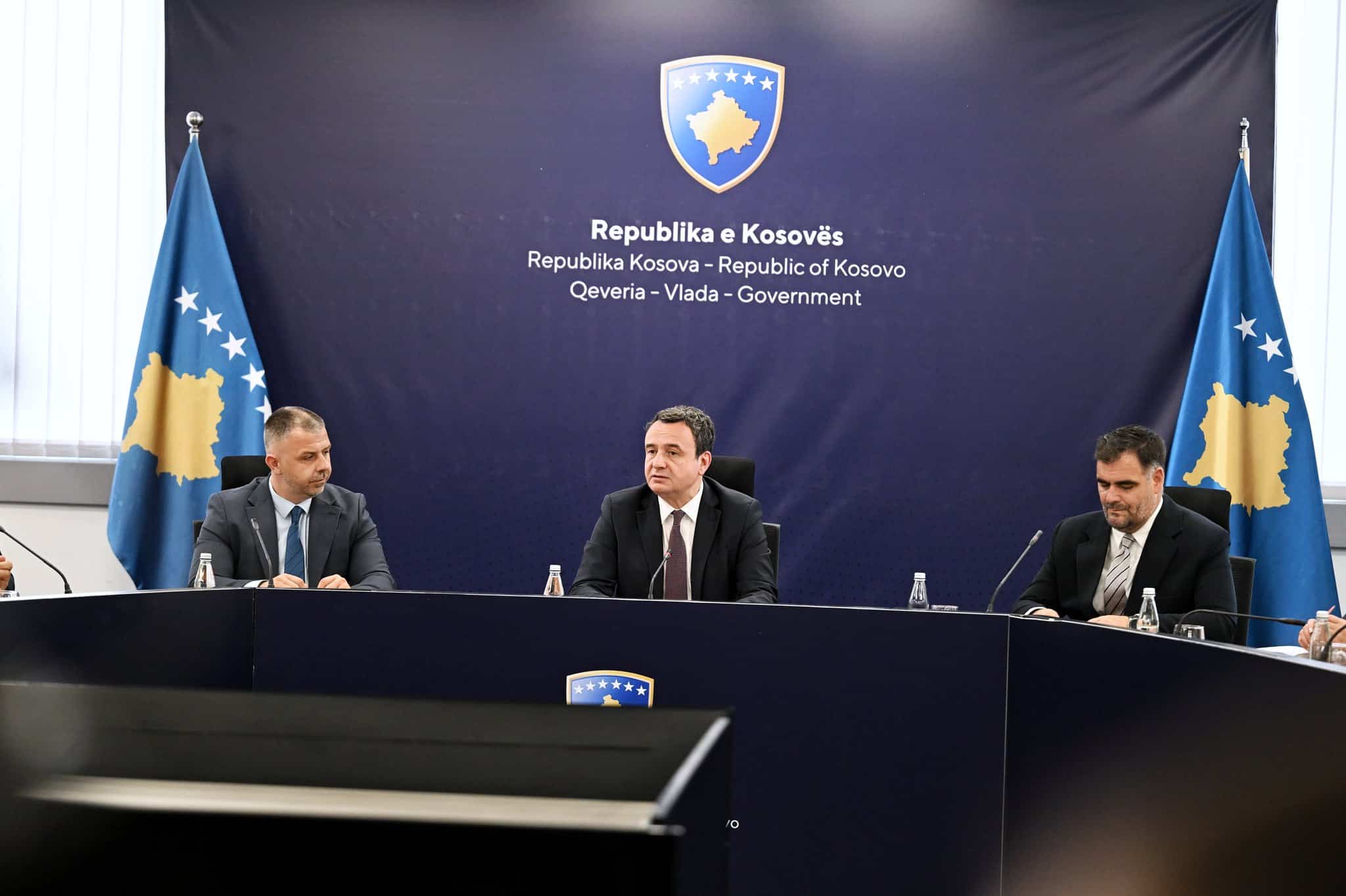
Prishtina, 29 August 2026
Honourable Member of Parliament, Mr Shaip Kamberi,
Honourable Mayor of the Municipality of Presheva, Ms Ardita Sinani,
Honourable President of the Albanian National Council, Mr Enkel Rexhepi,
Honourable Coordinators of the Albanian National Council in Medvegjë and Novi Pazar, Mr Arben Ferati and Ms Amina Nura,
Dear representatives from Presheva, Medvegjë, Bujanoc and Novi Pazar,
Representatives of civil society organisations, the media, culture and sport, students,
Ladies and gentlemen,
Distinguished guests,
Thank you for being here today, and welcome to our government, which is also yours.
For us, Presheva, Bujanoc, Medvegjë, as well as Sandžak, are not occasional issues. They are not matters that are raised only when there is a crisis. They are a permanent political, institutional and national responsibility.
For years, we have been dealing with a pattern of discrimination manifested in underrepresentation in the police, judiciary, administration and employment, the deactivation of addresses, the use of the Albanian language, and unequal access to public institutions. But oppression by the state of Serbia is not visible only in statistics. It is also visible in language. It is visible in conduct. It is visible in the way the state responds.
Precisely one week ago, when President of Serbia Vučić visited only Serbian-majority settlements in Medvegjë and Bujanoc, as well as a village in Presheva, using stigmatizing and derogatory language towards Albanians, a promise was subsequently heard from Vučić of employment with the BIA within 48 hours.
And this contrast is stark. When an Albanian seeks employment in public institutions, they face barriers and underrepresentation. When someone uses contemptuous language towards Albanians, they hear a promise of employment. This is an indicator of the climate. It is a message. It is how Albanians in these areas experience the state. And precisely for this reason, I am here today not only to speak to you, but to engage in dialogue with you.
We have built the Government of the Republic of Kosovo’s approach towards Presheva, Bujanoc and Medvegjë on three levels.
The first level is ensuring that citizens coming from these areas are as equal as possible to the citizens of Kosovo.
We have worked in education, healthcare, professional licensing, specializations, property rights and documentation. We have ensured equal treatment for patients from Presheva, Bujanoc and Medvegjë. We have created opportunities for the licensing of healthcare professionals. And this year we have taken another important step: specialists from the Valley have been placed on an equal footing with specialists from Kosovo, just as we had previously done with students.
We have enabled lawyers from the Valley holding residence permits in Kosovo to apply for the bar examination and to exercise property rights. We have worked to facilitate permanent residence for undocumented citizens and those whose addresses have been deactivated.
And we have worked to ensure that scholarship calls issued by the Ministry of Education are accessible to all students. Likewise, we have worked to ensure that calls issued by the Ministry of Culture are also accessible to you.
Thus, our aim is for an Albanian citizen from Presheva, Bujanoc or Medvegjë to face as few barriers and enjoy as much equality as possible when coming to Kosovo.
The second level is the creation of sustainable mechanisms to address the position of Albanians where they live.
For the first time, we established a regular budget line. In 2020, we allocated €500,000 to address the pandemic. In 2021, we allocated €100,000 following the floods in Presheva and €100,000 following the floods in Bujanoc.
Financial support increased from €2 million in 2022 and 2023 to €3 million in the 2024 budget, and to €4 million from 2025 onwards, including in 2026.
We have provided Albanian-language school textbooks and preschool materials for thousands of students every year since 2022.
In 2022, we supported 107 students through scholarships, and this number increased each year, reaching as many as 756 scholarships last year, depending on the number of applications and overall participation.
In 2023, we also introduced scholarships for secondary-school students and orphaned children.
We have supported culture. Cultural heritage. Sport. The media. Civic organisations. Children with special needs.
In July 2025, we allocated €580,000 for the co-financing of the School of Music and Museum in Presheva.
In 2022, we signed a Memorandum of Cooperation with the Albanian National Council. Through this cooperation, a regular institutional mechanism was established for all these decisions. For this cooperation, I would like to especially thank the President of the Albanian National Council, Enkel Rexhepi.
The third level is international advocacy.
Because many of the problems faced by Albanians in Presheva, Bujanoc and Medvegjë cannot be resolved through financial support alone.
Discrimination is institutional. It is political. It is administrative. It is linguistic.
It exists in employment. It exists in the police. It exists in the judiciary. It exists through the deactivation of addresses. It exists in weak representation in public institutions.
For this reason, we have supported international advocacy. In Brussels. In Washington. In New York. In the European Parliament. In the Council of Europe and in the most important European capitals.
Because discrimination that is not documented is relativized. Discrimination that is not measured is minimized. Discrimination that is not internationalized remains a local problem.
And we do not want the position of Albanians in Serbia to be treated as a local problem, because it is a matter of human rights, the rule of law, and the responsibility of a country seeking membership of the European Union.
And this is precisely where the issue for which we have gathered today comes in. We have two transfers that have been blocked: one in January of this year, amounting to €304,511, and another in April of this year, amounting to €1,837,511, or more than six times the amount of the earlier transfer.
Behind these funds lies an entire architecture of programmes that are important to the lives of Albanians:
• 78 projects approved in the fields of art, culture and cultural heritage.
• 23 projects in sport.
• 13 projects concerning the official use of the Albanian language and national symbols.
• 7 organisations working with children with special needs.
• 15 applicants assessed in the field of information and media in the Albanian language.
These alone account for 136 approved projects and organisations.
There are also 61 approved applications and families for students who have lost one or both parents.
But this is only part of the picture, because these funds also cover:
• the free textbook programme for primary-school students;
• the professional internship programme of the Albanian National Council;
• the programme for the expansion and maintenance of the Council’s offices in Presheva, Bujanoc, Medvegjë and Novi Pazar;
• and the programme for advocating the rights of Albanians in international centres.
So, we are not talking only about organisations that have been awarded projects.
We are talking about pupils. About students. About interns. About children with special needs. About athletes. About artists. About the media. About activists and institutions.
And about the very capacity of Albanians to organize themselves and represent themselves.
This is why the blocking of these funds cannot be measured only by the total amount in euros.
The real damage is measured by the opportunities that are lost. By the book that cannot reach the student. By the internship that the young person cannot begin. By the cultural project that remains only on paper. By the club that cannot carry out its activity. By the media outlet that cannot develop its programme in Albanian. By the family that does not receive support.
And by the Albanian National Council, whose ability to exercise in practice the powers granted to it by law is being blocked.
The funds are transparent.
• It is known where they come from.
• It is known how much they amount to.
• It is known what they are for.
• It is known through which institution they must be transferred.
• It is known who the beneficiaries are.
Thus, it is known where they will end up.
Therefore, this cannot be presented as a technical banking matter when a Serbian minister publicly confirmed that the funds had been blocked and returned.
It is an institutional responsibility. And Serbia must provide an answer.
Therefore, the funds must be unblocked. They must reach the bank account of the Albanian National Council. The approved projects must be implemented. The programmes must continue. And this practice must not be repeated.
And we are calling on the European Union to demand from Serbia, as a candidate country for membership, what Europe itself considers fundamental: the rule of law, equality, non-discrimination and effective protection of minorities.
The Government of the Republic of Kosovo will continue its support. It is our national responsibility to ensure that Albanians from these areas are as equal as possible to the citizens of Kosovo when they come here.
To build sustainable mechanisms that support Albanian life where it develops every day.
And to document and internationalize the systematic discrimination against them, making it part of Serbia’s responsibility before its international partners.
Because it is not enough for an Albanian from Presheva to be treated well in Prishtina. They must also have rights in Presheva.
It is not enough for a student from Bujanoc to receive a scholarship in Kosovo. They must also have prospects in Bujanoc.
It is not enough for a doctor from Medvegjë to be licensed in Kosovo. They must also have the opportunity to work with dignity, in their profession, there in Medvegjë.
It is not enough for a young person from Novi Pazar to attend Albanian-language courses. They must also have the opportunity to preserve, protect and strengthen their national and cultural identity.
And it is not enough for us to know that discrimination exists. Brussels, Washington and Strasbourg must know it too. And so must every institution that assesses Serbia on democratic standards and human rights.
Distinguished guests,
Brothers and sisters,
I am here today to engage in dialogue with you. To hear directly from you about the practical, concrete problems. To turn them into institutional action. And to continue this policy with even greater clarity, more mechanisms and greater responsibility.
The funds must be unblocked. The projects must be implemented. Equality must be upheld. And the rights of Albanians must be protected where they live.
Thank you very much for your participation and for your attention!