
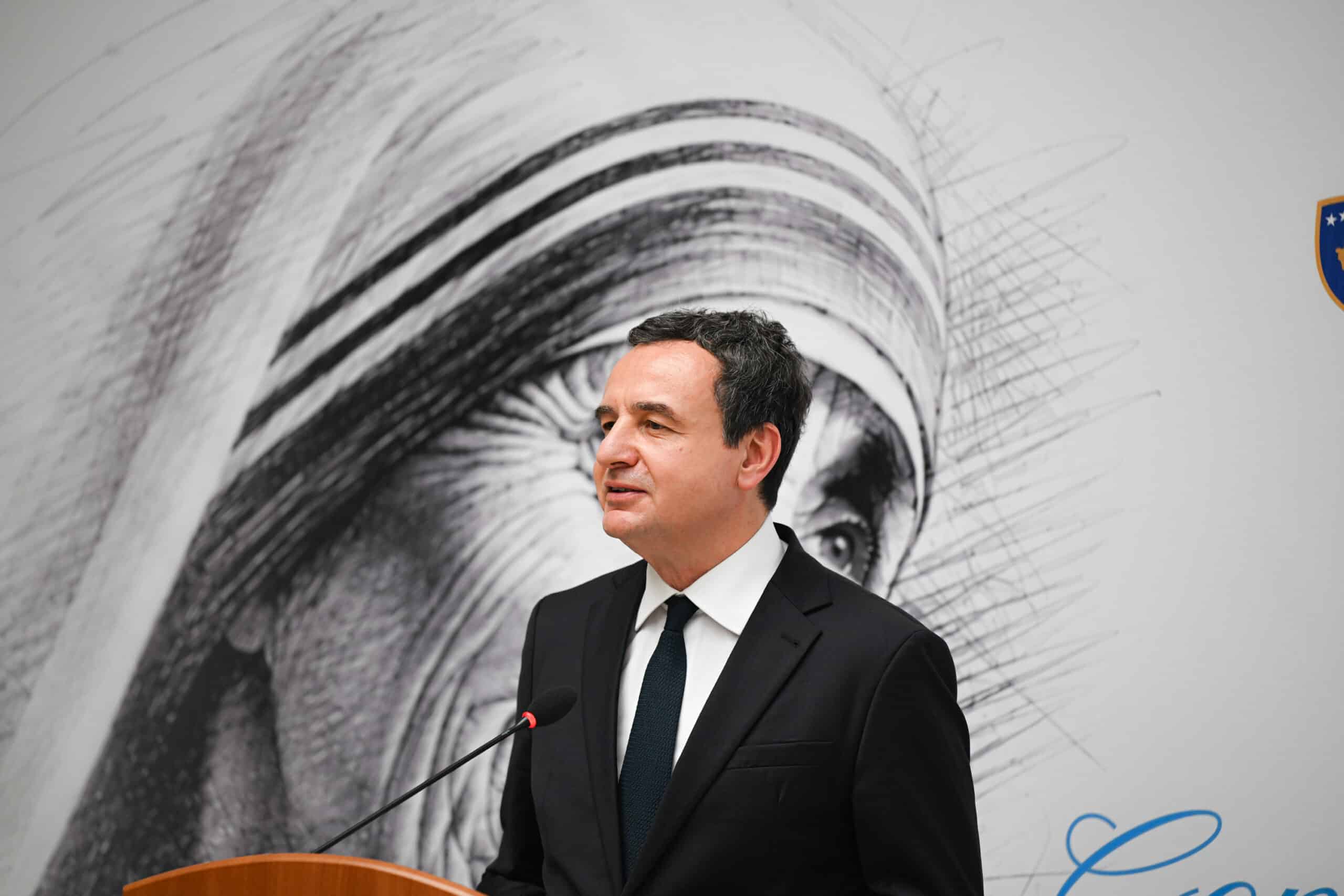
Prishtina, 5 September 2026
Honourable Deputy Minister of Culture and Tourism, Ms Nora Arapi Krasniqi,
Honourable Deputy Minister of Defence, Mr Gegë Lleshi,
Honourable Ms Blerina Rogova Gaxha, Director General of the National Library of Kosovo,
Honourable Mr Bernard Çobaj, Ambassador of Montenegro to the Republic of Kosovo,
Honourable Professor Skënder Asani, author of the work,
Honourable Don Lush Gjergji, reviewer of the work,
Dear attendees,
Ladies and gentlemen,
Sisters and brothers,
For decades, much has been said and written about Mother Teresa, this illustrious figure whom the Albanian people gave to the world with our characteristic generosity.
Today, we have in our hands a work that recounts Gonxhe’s journey towards becoming a missionary of the human spirit and, ultimately, a saint of the peoples. A great woman who emerged from a relatively small nation and who, for as long as she lived and breathed, offered unconditional help and compassion.
Alongside the tenth anniversary of her canonization by Pope Francis, today we cannot but remember 5 September 1997, when the humanitarian Gonxhe Bojaxhiu physically departed from this life in Calcutta. It was not by coincidence that the United Nations declared 5 September the International Day of Charity, honoring in a dignified manner her life’s work.
To dedicate one’s life to others is the noblest, and at the same time the most difficult, mission that a human being can undertake.
This was the choice of Mother Teresa, the girl from Skopje, born into an Albanian family, the daughter of Kolë Bojaxhiu from Prizren and Drane Barnaj from Novosella of Gjakova, raised in a spirit of kindness and responsibility to help those most in need. And it is precisely this journey that is described in the work being promoted today, “The Missionary Journey of Gonxhe Bojaxhiu Towards the Universal Mother Teresa”. This is a major work by authors Skënder Asani and Albert Ramaj, whom I take this opportunity to thank for their academic, historical, cultural and spiritual contribution.
In the 1950s, the thinker Carl Gustav Jung, the founder of analytical psychology, wrote, and I quote: “Who looks outside, dreams; who looks inside, awakes.” Thus, the awakening of the mind and spirit is directly related to the inner being of each and every one of us. Our inner being is the essence of our existence, from which the most precious values we possess as individuals come to life. When these individual qualities intertwine with others within a community, the full human potential is achieved. In Mother Teresa, this potential was nurtured within the Bojaxhiu family, developed in the community in which she grew up, and gained global momentum through her spiritual calling. The cultural and religious environment in which she received her initial formation and education was Skopje, where her sense of solidarity and responsibility towards others first began.
It was there, therefore, that Gonxhe Bojaxhiu learned and brought together peace and love, which would later give rise to her charity towards others.
However, what makes this work unique and special is the fact that it focuses on family and community records, shedding light on the factors that paved the way and served as the foundation for the formation of the universal Mother Teresa.
Her letters and photographs from that period portray the simple woman before she became internationally known. Meanwhile, her journey through different parts of the world broadened her horizons and strengthened her conviction in her sacred mission—first in Croatia, then in Ireland, and later in India. Throughout this journey, Gonxhe devoted herself completely without losing her identity. As I have also emphasised in the foreword, she became a bridge, not a wall.
In our times, more than ever, bridges are of vital importance. They connect us to one another, they are gateways to mutual understanding and, ultimately, the key to a better world. Today’s work places this concept at its very center, as the periodicals Katoličke Misije and Blagovest constitute two principal pillars that are closely interconnected. The former documents Mother Teresa’s early experience of her missionary calling. The latter preserves the collective memory of the community in which she was born and formed. Together, they offer us a rich picture containing original information and historical and scholarly perspectives, complemented by personal nuances from her life within her family and community.
Furthermore, the work in question is complemented by two scholarly reviews by Mother Teresa’s biographer, Dom Lush Gjergji, and historian Prof. Dr Martin Berishaj, who explore questions of historiography through a humanistic and spiritual interpretation, as well as aspects of her personality, reflections and experiences throughout the course of her life.
Therefore, it is both a privilege and a responsibility for me to write the foreword to this work, which today enriches the documented body of Mother Teresa’s life.
Dear authors, I assure you that the Government of the Republic of Kosovo holds your work and commitment in the highest regard, as well as your energy and dedication to this undertaking of national and historical value.
Dear fellow citizens, I invite you to read this work and encourage others to pick it up as well—not only to deepen their knowledge through this book, but also to remind ourselves of the importance of properly understanding our history and the distinguished individuals whom the Albanian nation has brought forth.
Thank you for your attention!