
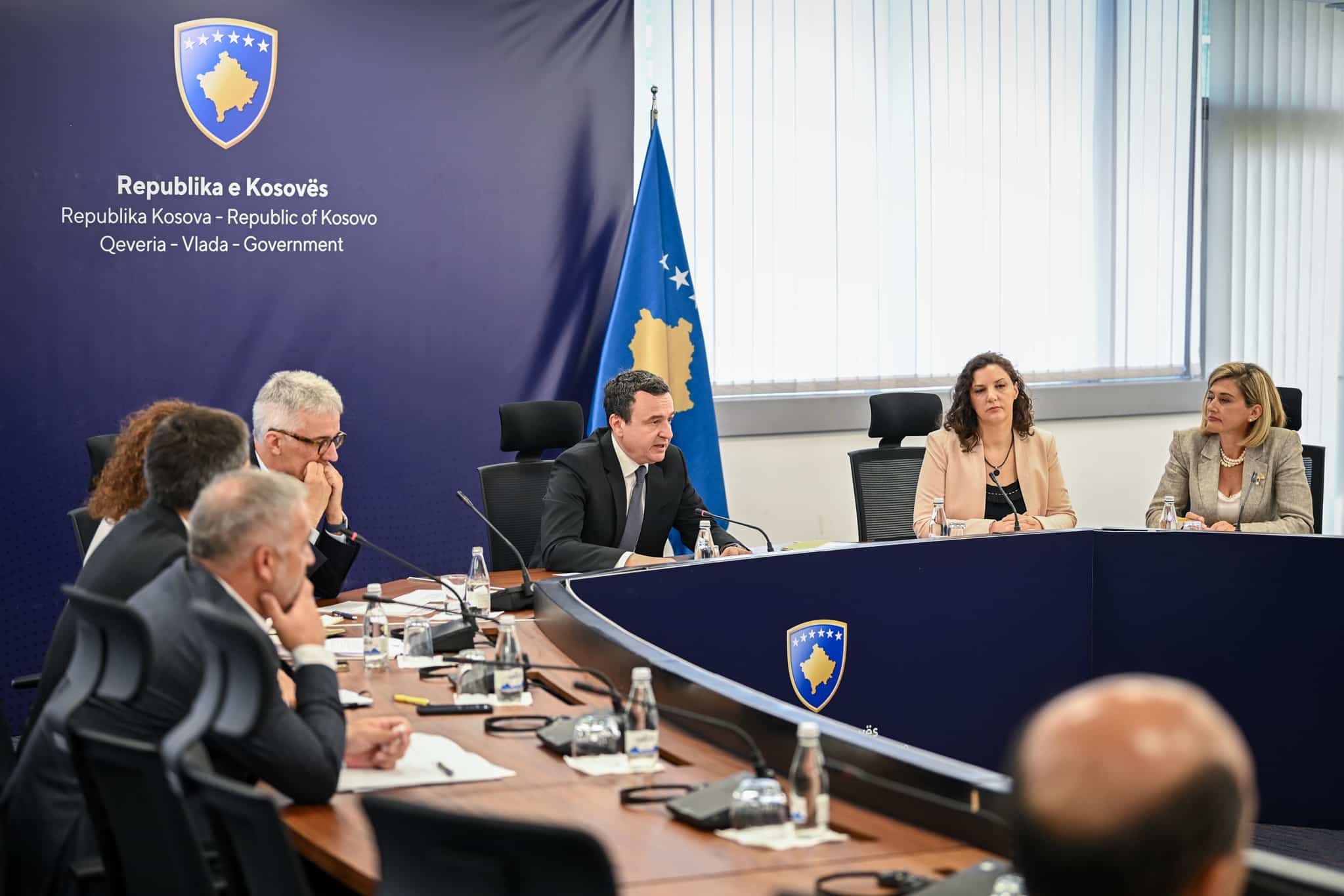
Prishtina, 1 September 2026
Dear Ms. Artane Rivaznolli, Minister of Economy,
Dear Ms. Mimoza Kusari-Lila, Minister of Trade, Industry, Entrepreneurship and Inovation,
Your Excellency, Mr. Rainer Rudolph, German Ambassador to Kosova,
Dear Dr. Zoran Morvaj,
Dear GIZ and ITP team,
Distinguished representatives of our institutions, universities, businesses and civil society,
Dear researchers,
Ladies and gentlemen,
Thank you for being here today.
When discussing the energy transition, we typically envision power plants, solar panels, wind turbines, and transmission lines.
Yet, none of this infrastructure is built without the knowledge that precedes it. Before any new capacity goes up, someone must measure it, calculate it, and think it through. That knowledge does not just appear on its own. It must be created, maintained, and kept or it will be lost.
It is worth recalling what research and development actually means, as the term is often used loosely. Internationally, R&D is defined as creative and systematic work undertaken to increase the stock of knowledge. To qualify, it must satisfy five criteria: it must be novel, creative, uncertain in its outcome, systematic, and its results must be transferable or reproducible.
Let me draw your attention to the third criteria: outcome uncertainty. Uncertainty is not a weakness of research; it is part of its definition. A government that funds research is funding work whose results cannot be promised in advance. That is uncomfortable for any ministry of finance anywhere in the world, and it is exactly why research does not get funded unless a country decides, deliberately, to fund it. We soon need and want to make these kinds of decisions.
In the decades since the war, Kosova has too often depended on analysis commissioned or produced elsewhere. Studies of our own energy sector have frequently been written by people who know our country better from spreadsheets data tables than from the actual terrain.
The external analyses have been useful, and we are grateful to our partners for them. However, a country that fails to produce its own knowledge will, sooner or later, find itself making vital choices based on someone else’s assumptions and priorities.
This is why research and development cannot be treated as a luxury reserved for wealthy nations alone. Most of the technology the green transition requires will not be invented in Kosova, and it does not have to be. But importing technology is not the same as acquiring capability. A country can only effectively use what it can understand, adapt, and apply to its own particular conditions. Economists call this absorptive capacity: the ability not simply to acquire technology, but to learn from it and make it work for us. That capacity does not ship alongside the equipment. It must be built here, and it must be preserved here.
The purpose of a national institute for the energy transition should be precisely this: to create a place where knowledge stays. Not a project that begins and ends with a grant. Not a report that gathers dust in a drawer after the presentation. But an institution with a memory, one that outlasts the project cycle and the political cycle alike. And it cannot operate in isolation. Its value would depend on its connection with universities, businesses and public institutions, and on its ability to turn research into knowledge that Kosova can use.
There is something else I want to say here, because it is always on my mind. We have an asset we tend to forget when we draft new policies and focus only on the people who live and work inside Kosova: our other people abroad. In Germany, Switzerland, Austria, the Nordic countries, and across the Atlantic ocean, there are engineers, doctoral candidates, professors and energy specialists of Kosovar origin. A massive share of our people lives outside this country, and they represent an untapped reservoir of knowledge. And many of them want to contribute. Our diaspora should be invited not only for holidays and for the summer, but also to work. An institute like the one we came here to discuss today would need to provide exactly that: a laboratory, a project, a contract, a team. The cooperation may be permanent or temporary, remote or right here on the ground but first of all, it has to be possible. I do not want to have an institute that conducts research and development without our diaspora. We are losing far too much potential, and we still do not fully grasp the range of possibilities our people abroad could open up for us.
And finally, the location. The Institute is proposed to be hosted at the Innovation and Training Park in Prizren. That is not merely a technical choice. It should reflect our commitment to inclusive regional development. Knowledge, investment, and opportunity must not remain concentrated in the capital town alone. Prizren has students, it has tradition, it has space, and it has an ecosystem that is already working.
Let me thank the Government of Germany and GIZ for their technical support in preparing this concept, Ambassador Rudolph for the partnership that continues to deliver, and Minister Rizvanolli and her team for the dedicated work that has brought us to this point.
I look forward to hearing the conclusions you reach today and the next steps you propose. I hope for an open and critical discussion.
Thank you very much!