
Prishtina, 3 August 2026
Honourable Ms. Saranda Bogujevci, Minister of Culture and Tourism,
Honourable Ambassador of the Republic of Kosovo to the Federal Republic of Germany, Mr. Faruk Ajeti,
Honourable Chargé d’Affaires of the Embassy of Switzerland, Mr. Christoph Fuchs,
Honourable Cultural Attaché of the Embassy of Germany in Kosovo, Ms. Catalina Heine,
Honourable artists,
Dear Elona Beqiraj, Sindi Zeneli and Blinera Berisha Gërvalla,
Dear ladies and gentlemen,
Distinguished guests,
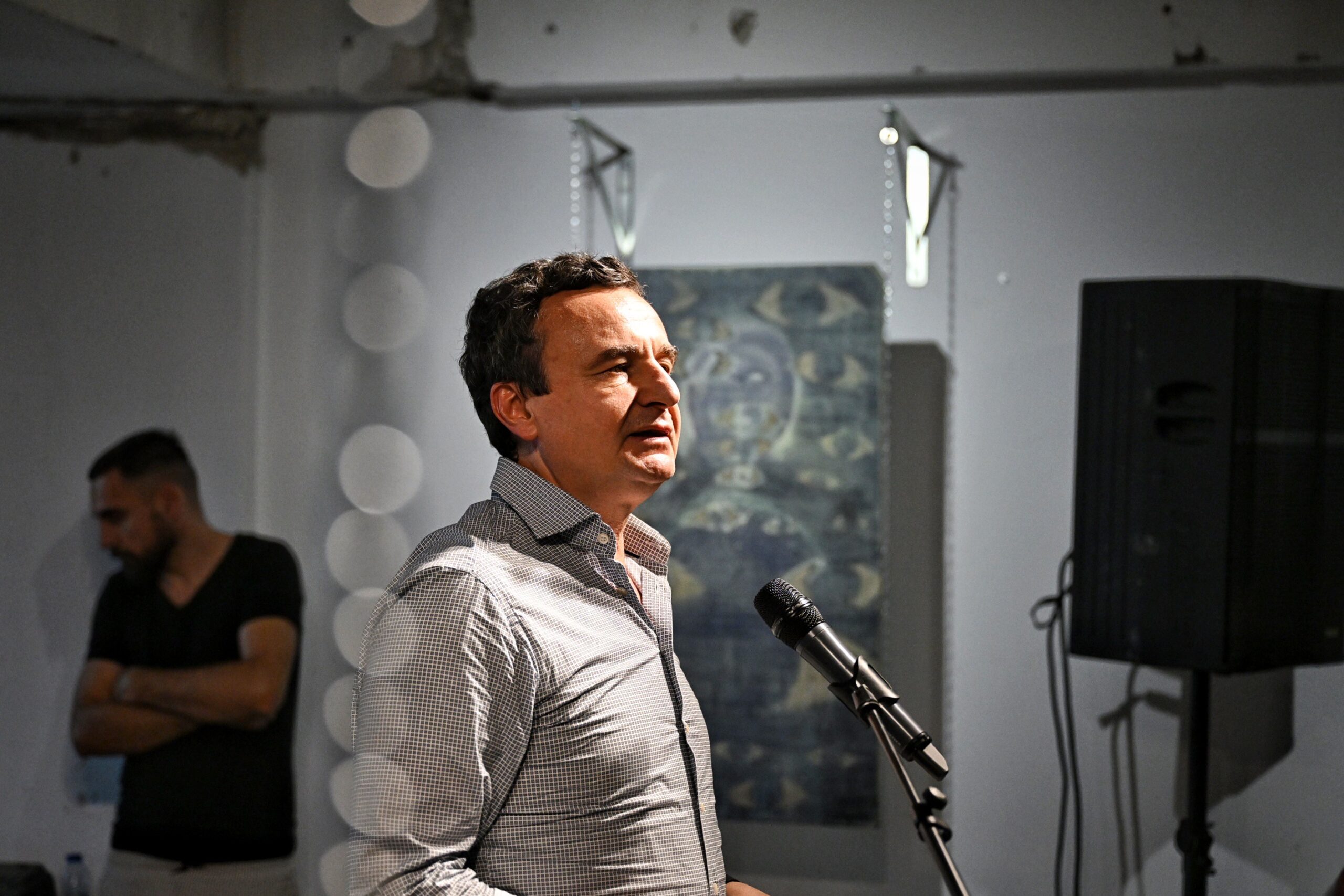
I am pleased that we are together here this evening to open this exhibition and this month-long cultural festival, which will bring together our artists from the diaspora to reflect on these decades of migration, longing and return.
Our diaspora is well integrated wherever they live. Yet with their hearts, minds and support, they have always remained in Kosovo.
During these summer holiday days, when once again we meet hundreds and thousands of our compatriots throughout Kosovo, we hear stories that have now been told over three or even four decades.
“At least once a year we come here, they say. Our children spent their holidays in Kosovo. Perhaps they wanted to go to the seaside, or somewhere else where their classmates spent their vacations. But every year, we came to Kosovo.”
The children, who sometimes grew tired during the long journeys while waiting at the border, would be told: “We have to go because your aunt’s son or your uncle’s daughter is getting married. Grandma has grown old. The house stands empty for eleven months of the year. We have to bring a car for our nephew.” And so on.
You always came with anticipation. And no one failed to ask you: “How long are you staying?” “Is it better here or there?” Every time there was a reason to come to Kosovo. Every time there was a reason to return to Germany, Switzerland, Sweden or America.
Neither there. Nor here.
But it was not always like this. During the 1990s, you hardly came at all. You didn’t have the opportunity.
It was your longing for your family, your love for your homeland and a hope, however uncertain, that sustained you.
Fear and hope, sorrow and joy, live together in the same heart for our diaspora. Not as contradictions, but as two wings holding together two worlds, so different from one another, yet both part of the same reality.
And when Kosovo was facing expulsions, killings and daily misery, it was you who showed the world what the Serbian regime was doing to the Albanians. In Geneva, London, Bonn and Washington, you took to the streets, holding countless protests and gatherings, and you raised your voice. You were the messengers of the liberation war throughout the world.
At that time, “neither there, nor here” was not a choice. It was a condition without a solution.
And the children of our compatriots, the generation that today holds the citizenship of the countries where their parents once sought refuge, grew up with sad news, with grieving parents and with a feeling that they were somehow different from others.
The other children seemed different, carrying fewer burdens. They would ask about your name, which sounded somewhat unusual to them, yet they could not pronounce it properly.
And it was precisely this duality that made you so strong.
Because the resilience of this generation was inherited from the resilience of their parents. It grew and transformed into creativity: into art, culture, science, business and achievements that today are recognised around the world, and whose true cost is known only to those who grew up in the diaspora.
And our blessing, the blessing of Kosovo, is that you did not keep those skills to yourselves. You did not assimilate. You did not forget your homeland. Instead, you speak of it with pride. You speak of this people who have endured, and you take pride in our resilience.
Allow me also to speak about those who stayed behind.
Because this festival is not only about those who left. Its title also makes room for those who remained here: those who welcomed and bid farewell to their loved ones, who kept the house, the village, the school, the hospital and the language alive. They, too, have known what it means to live with a suitcase by the door. Only, the suitcase belonged to someone else.
That is why this evening, on this floor, it is not two sides that are meeting. It is one people.
To live in two worlds means living a doubled life. Twice the joy, but also twice the burden.
“Best of both worlds” may sound appealing in an advertisement. In real life, however, that “both” comes at a price. Because living a doubled life also means this:
When someone dear to you passes away while you are eighteen hundred kilometres away, the first thing you do is calculate: how many hours by car, whether there is a flight tonight, whether you can make it by tomorrow afternoon. And sometimes, you cannot.
When your sister or brother is getting married, and you requested your annual leave back in January, but your employer says no because there is no one else to work in August. Yet you come anyway, after three sleepless nights on the motorway. Or you do not come at all, and you carry that feeling of absence and guilt with you for many years.
When, at the end of the month, you have a certain amount of money in front of you, you know that you can either send it to your mother for medicine or firewood, or pay for your own child’s guitar lessons. Both are the right choice. Both are acts of love. Yet you have to choose only one.
When you build a house here, in your village, with the savings of a lifetime, and someone always asks you: “Who are you building it for? Are you planning to come back?”
This is not a complaint. It is simply the everyday arithmetic and geometry of our diaspora.
Twice the love, twice the responsibility. Two homes, two rents. Two languages, twice the longing.
And tonight, as Prime Minister of the Republic, I want to say one thing clearly: we know. We know that every euro sent to Kosovo was a euro that could otherwise have been spent on your own child’s guitar lessons or other needs at home. And we do not take that for granted.
Because “Neither There, Nor Here” is not only the condition of the diaspora. It is also a question addressed to the state.
It is easy to thank the diaspora in July and August. At the airport, in speeches, by looking at the licence plates of their cars, at the many weddings, over lunches and dinners.
The real task is to make return possible. To ensure that the girl born in Stuttgart and the boy born in Zurich have reasons to come not only for holidays, but also to work, invest, settle, create, live and thrive in their homeland.
Our duty is not to ask more of you. Our duty is to ensure that you have to choose as rarely as possible. That coming to Kosovo is no longer a sacrifice, and staying here is no longer a loss.
Alongside the initiatives we have already undertaken, we are expanding programs that strengthen the participation of the diaspora in our country. Allow me to mention three of them, because all three are dedicated to you.
First. We are fully digitalising consular services. For most administrative services, there will no longer be a requirement to appear in person at a consulate or embassy. No more long waiting lines. No more spending an entire day travelling just to obtain a stamp.
Second. Through the “Diaspora Investment Window”, we will continue to support entrepreneurs from the diaspora, covering investments of up to one hundred million euros made in Kosovo. The state will also act as guarantor for diaspora investments. Your Republic stands as collateral for the diaspora’s investment loans, the diaspora of the Republic that will always be yours.
Third. In Prizren, at the Innovation and Technology Park, we are developing Kosovo’s first research and development centre in the field of energy, in cooperation with German partners, academia and professionals from our diaspora.
Because the diaspora is not merely a source of remittances. The diaspora is knowledge: engineers, doctors, researchers, architects, teachers, artists. And we are opening a door through which that knowledge has both a reason and a way to come.
That is why we are here tonight.
Elona, who initiated this festival, published a book of poetry in Germany a few years ago. She titled it: “And We Came Every Summer” (Dhe ne vinim çdo verë). The biography of an entire generation is contained in that book.
Elona, Sindi and Blinera, from Berlin, but also from Rugova, Tirana, Prishtina and Vlora, are here with us this month. Here, at the Grand Hotel.
Together with them are fourteen artists: from Germany, Switzerland, Belgium and the Netherlands, from Albania and North Macedonia, and from Kosovo. Installations, paintings, photographs, short films, poetry and literature. Fourteen different ways of expressing the same message: that distance has not diminished the bond.
And all of this is open to everyone, free of charge. Just as culture and art should be: free and accessible to all.
The exhibition will remain open until 29 August. I invite you to tell your relatives and friends that this year, in Prishtina, the place to visit is the Grand Hotel, on its sixth floor.
Distinguished guests,
For many years, we have treated “Neither There, Nor Here” as a wound. As something that needed healing. As something that had to be resolved: either here or there.
It tells us that the space in between is not empty. It is a place. It is our place. A place with its own language, its own humour, its own music, its own sorrow and its own joy.
How fortunate our diaspora is to have that culture, that humour and that language, while also having this culture, this humour and the Albanian language.
That is why our diaspora is not half there and half here. It is so whole that it is, in a sense, more than whole. It is exactly as we are seeing, reading and experiencing together: both here and there, and there and here. Especially the younger generation, which represents something entirely new, something that we ourselves are still trying to find the right name for.
The Albanian language spoken with an accent is no lesser Albanian. It is Albanian that has travelled farther.
Therefore, Elona, Sindi and Blinera, thank you for organising this festival.
And now, I will leave the floor to the music. This evening, Agona Shporta and Tringa Sadiku will perform.
Thank you very much.