
Prishtina, 28 October 2026
Honorable Chairman of the Islamic Community of Kosovo, Mufti Naim Tërnava,
Honorable Chairman of the Muslim Community of Albania, Bujar Spahiu,
Honorable Reisul Ulema of the Islamic Religious Community of the Republic of North Macedonia, Shaqir Fetahu,
Honorable Director of the Institute for Islamic Research and Studies, Sabri Bajgora,
Distinguished professors and academics,
Distinguished researchers and students,
Ladies and gentlemen,
Sisters and brothers,
Allow me first to express my condolences on the passing of Bahri Efendi Simnica, a professor at the “Alaudin” Secondary Madrasa in Pristina, where he also served as director, and former editor-in-chief of the magazine “Dituria Islame”, may you all, God willing, meet him in Paradise.
The capacity and opportunities to produce and organise knowledge, from research and study to discussion, and from reflection and theorising to writing, are decisive for the longevity of a society and its progress throughout history.
One of the challenges facing every people, in every civilisation and every era, has been and remains the creation of bridges that enable knowledge to be passed from one generation to the next. The history of humanity has witnessed many periods of cultural birth and rebirth, but for us, since the Age of Enlightenment, when the foundations and principles of modern science were laid, civilisations have developed in an era of the unceasing advancement of knowledge through science.
I come here to join you after holding this morning’s regular meeting of the Government of the Republic of Kosovo, at which, among other things, we adopted a decision proposing the National Science Council to the Assembly of Kosovo as one of the institutional links through which our state supports science and scientists.
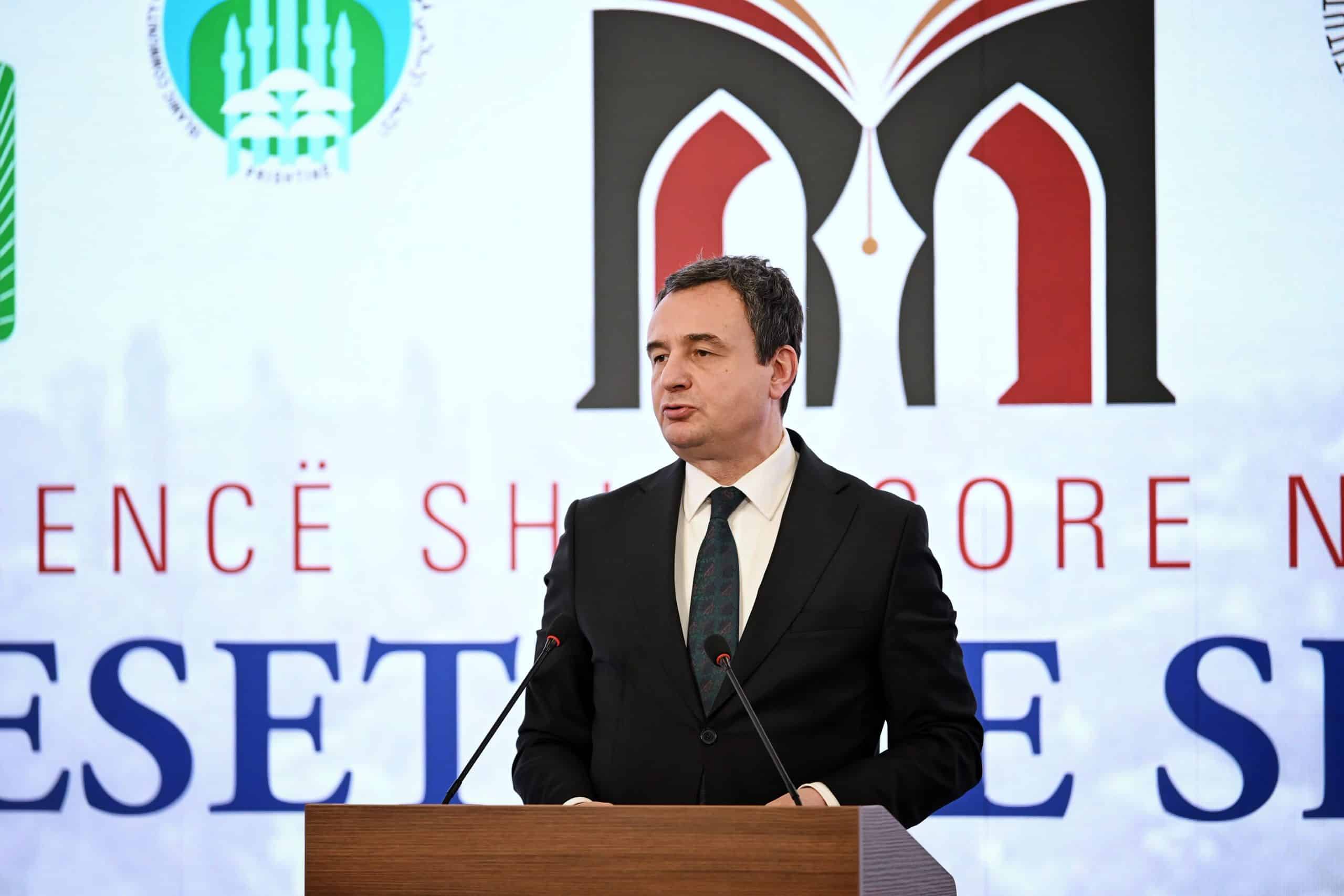
At this point, I am particularly pleased to see that, here in our capital, Pristina, a forum is being held today for researchers from all Albanian-inhabited territories, as well as international scholars from various countries, at this scientific conference on madrasas among Albanians.
Religions, together with the arts, represent two of humanity’s most universal cultural expressions. The human need to believe in metaphysical entities and the ritualisation of those beliefs through transcendental practices appear to be closely connected to the very essence and existence of the human being.
Throughout much of the XX century, maktabs and madrasas among Albanians were regarded more as anti-schools than as schools. This was because, in Albania, under the harsh communist regime, religions were banned by law in 1967 and religious schools were generally closed, while much of their book heritage was destroyed, and they were condemned as centres of foreign indoctrination and backward ideas, as they were described at the time.
Meanwhile, Albanians who remained under Yugoslavia, in its various republics – namely, Albanians in Kosovo, Macedonia and Montenegro – were denied, restricted or deprived of their right to education in their mother tongue in countless ways. In these circumstances, there were not a few instances in which madrasas were politically instrumentalised by the Yugoslav regimes as alternative schools.
All of this took place within the framework of racist, depopulation and assimilation policies pursued by Serbia. By formally emphasising Islamic elements of identity, particularly those of Turkish origin, these policies sought to pave the way for the stigmatisation of Albanians as a national minority, supposedly a remnant of the Muslim population from the Ottoman period, thereby justifying the mass expulsion of Albanians to Turkey. This was an extremely insidious method of ethnic cleansing aimed at removing the indigenous Albanian population from Kosovo and other Albanian-inhabited territories.
Fortunately for us Albanians, decades of efforts, sacrifice, resistance and struggle were rewarded in the final decade of the last century with the fall of the communist regime in Albania and the liberation of Kosovo from Serbian occupation, followed by the establishment of the state of Kosovo. Today, madrasas in Kosovo and Albania therefore operate freely, both as religious schools and as educational and scientific institutions within our education systems.
Furthermore, the history, heritage and contributions of madrasas among Albanians can now be studied freely and brought to wider public attention by scholars such as yourselves and by anyone interested in this subject.
By presenting your research on the history and heritage of madrasas among Albanians, you are therefore restoring and recovering a distinct culture and tradition of religious schools, subjecting them to scientific study and giving them their rightful place in our history.
As is well known, from the fourteenth and fifteenth centuries, when the Ottomans arrived in Albanian-inhabited territories and expanded into other parts of this region of Europe, Albanians became one of the many peoples who, until the beginning of the XX century, lived within the Ottoman imperial realm alongside more than 40 other peoples and communities.
Over this long period, Albanians and other peoples underwent complex processes shaped by numerous traditions and cultures, and Islam was adopted by the majority of the population. As a result, many madrasas were established and operated among Albanians, from the madrasa of Ishak Bey in Skopje and that of Gazi Ali Bey in Vushtrri to the madrasa of Haxhi Sinani in Berat and that of Sultan Selim in Prishtina.
During the Ottoman centuries and in the period that followed, madrasas were schools where distinguished Albanian scholars studied and wrote. Their written works continue to enrich the manuscript and book collections held in our libraries and archives. These scholars were known from Skopje and Shkodra to Istanbul and included, for example, Haxhi Iljaz Efendi Prishtina, Hysen Nexhmedin Efendi Prizreni, Bajram Efendi Peja, Vehbi Dibra, Hafiz Ali Korça, Adem Nuri Efendi Gjakova, Hafiz Aliriza Efendi Ulqinaku and many others. Beyond their contributions to Islamic sciences, secular scholarship and the cultivation of religious faith, these scholars and religious leaders, as well as the madrasas themselves, made valuable contributions to the Albanian National Renaissance. They taught the importance of loving one’s homeland and fighting for its freedom until death, or, as the saying went, homeland and faith go hand in hand. This is best evidenced by the 38 clerics and imams who took up arms as fighters of the KLA (Kosovo Liberation Army) and became martyrs of the nation during the most recent war.
On my way here, while looking through the programme of this conference, I noticed that a total of 57 papers were scheduled for presentation. I hope that the institutions and everyone involved in organising this conference will also ensure their publication, so that the findings of these scientific studies remain accessible beyond the two days of this conference and beyond our own time.
I congratulate you on your research and on this scientific conference, and I apologise if my remarks have lasted longer than the ten academic minutes that, somehow, never seem to be enough for us.
Thank you once again!