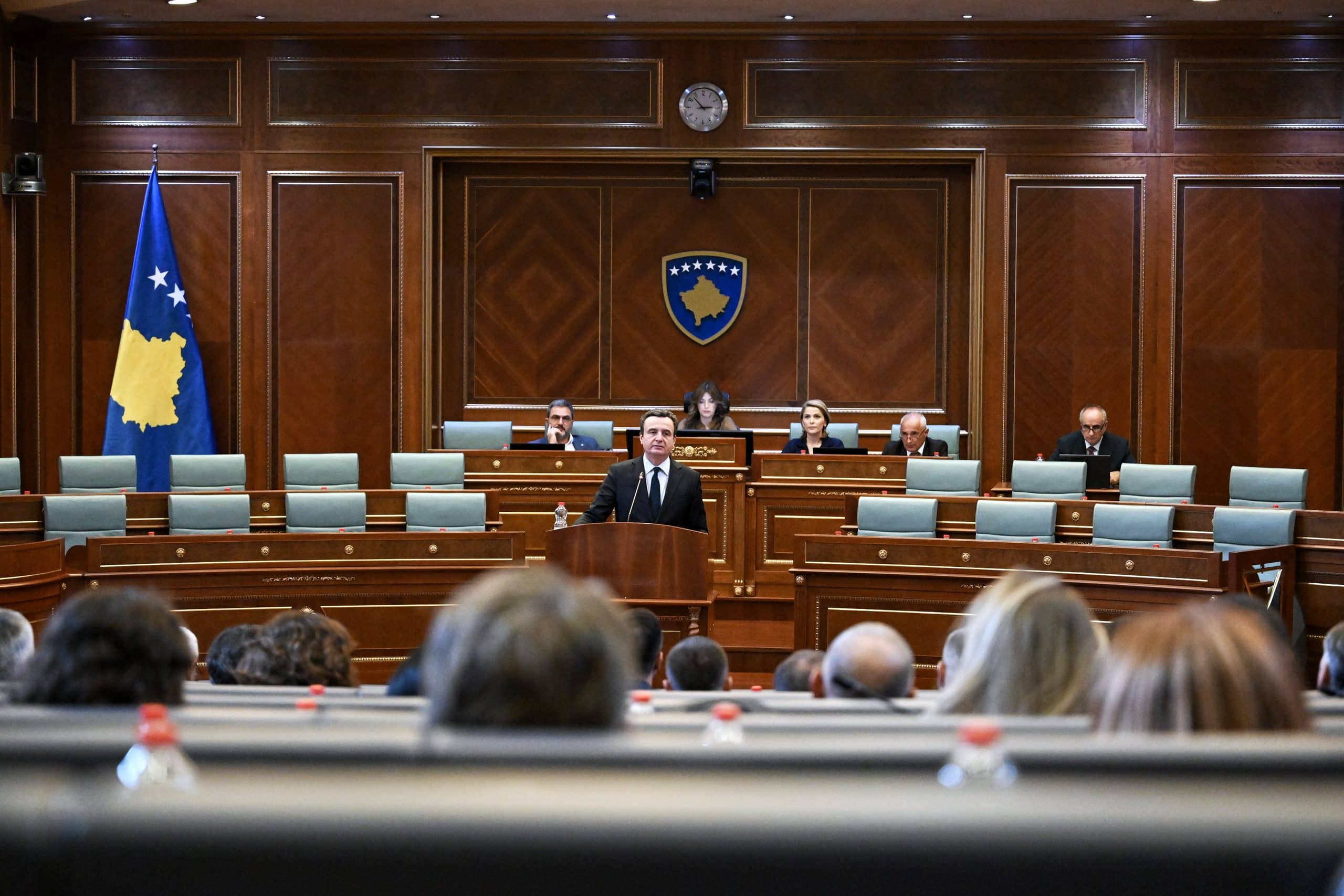
Prishtina, 13 September 2026
Honourable Speaker of the Assembly of the Republic of Kosovo, Ms Albulena Haxhiu,
Honourable Deputy Speakers of the Assembly of the Republic of Kosovo, Ardian Gola, Kujtim Shala, Emilija Rexhepi and Tanja Vujoviq,
Honourable Members of the Assembly,
Dear citizens of the Republic of Kosovo,
Honourable members of the diplomatic corps,
Families of the nation’s martyrs, war invalids and veterans of the Kosovo Liberation Army,
Honourable officials of our state,
Ladies and gentlemen,
I congratulate you in the constitution of the Assembly of the 11th Legislature and on the new functions and responsibilities you have assumed. I thank each and every one of you for the commitment and for the trust you place in our common state.
In recent days, we have all been anxiously awaiting the decision in the trial of the KLA leaders Hashim Thaçi, Jakup Krasniqi, Rexhep Selimi and Kadri Veseli. The prosecution’s request is unjust and implausible because it is at odds with the historical truth of our people and the just cause of our liberation war.
The position of the Government of the Republic of Kosovo that I lead is clear and remains unchanged: crimes against humanity, war crimes and genocide were committed against the Albanian civilian population in Kosovo. They were committed by the regime of Yugoslavia under Milošević, led by Serbia. No domestic or international court can tarnish the KLA.
Honourable Members of the Assembly,
I will not, in fact, deliver a new address, because these repeated elections have merely interrupted the same course of governance. I will therefore try to be briefer and present the new Government Cabinet.
Our vision throughout these years in government has been to work for the citizen and protect the family. Our Government is a service to the public, not a privilege for the few. Our investments build a secure state and secure citizens, and foster a prosperous society and prosperous families.
This mandate is about firmly restoring security and well-being to citizens’ daily lives, and making investment and production the norm in entrepreneurship.
In our firm conviction, as reflected in our programme and projects, social redistribution is not a burden on economic development; it is its fuel. By distributing the gains of economic growth, we have reduced poverty and inequality and increased aggregate demand in the economy, which in turn has increased business turnover and further economic growth.
We do not subsidise wealth, but the work that creates it; not particular private interests, but a universal public approach. When the state guarantees investment, risk decreases and courage increases.
Over the past five years, nearly a year and a half of which we spent as a caretaker government without full executive powers, we have built and developed a fairer, stronger and more inclusive Kosovo. Despite numerous challenges, including the pandemic, the energy crisis and inflation, we achieved the highest economic growth in the region, with average Gross Domestic Product growth of 6% and no annual rate below 4%. In the first quarter of this year, GDP grew by 5.4%. When we assumed responsibility for leading the country, GDP was approximately EUR 7 billion. Last year, through honest work and sound policies, it reached EUR 11 billion, while we project that GDP will reach EUR 12 billion this year.
In terms of employment, we increased the number of people employed from 350,000 to 430,000, with a focus on young people and women. By raising the minimum wage, pensions, child allowances and public-sector salaries – which increased by an average of 47% during the mandate we have just completed – we have increased household incomes, spread prosperity and strengthened social security for the entire population. This growth will continue in the coming mandate, in line with budget growth and economic performance, raising the average public-sector salary to more than EUR 1,000 per month. As you know, we have not kept the benefits of economic growth within the state; we have distributed them among the people. Child allowances, which today range from EUR 30 to EUR 45 for every child, will be doubled in the next mandate. They stood at zero when we took office, and we raised them to EUR 45, and in the next mandate, they will rise from EUR 45 to EUR 90 per child for families with three or more children. With this increase, we will surpass several European Union countries in terms of child allowances. In addition, from 1 July, we increased maternity allowances for new mothers to EUR 500 per month for six months.
Honourable Members of the Assembly,
We worked for mothers and children, for the north of the country, the army and agriculture, and this work will continue in the new mandate, for which I ask for your support here today, so that we may begin the greatest economic and industrial transformation in our country.
Production is the foundation of our economic development. The Development Bank will directly finance strategic projects, support small and medium-sized enterprises through banks, and provide producers and exporters with letters of guarantee for payments. The EUR 1 billion programme for production and industry will guarantee loans for investment in new production capacity, including the creative industries and wage-subsidy schemes. Investors who produce and create jobs will find it easier and less costly to obtain credit. With accelerated depreciation, a larger share of the investment will be deducted in the early years, when businesses face higher costs and have a greater need for working capital.
We have returned the customs terminals to the state and begun preparations to modernise them. Having dismantled the monopoly on fiscal cash registers, we will introduce electronic invoicing between businesses, with real-time monitoring of liabilities and faster Value Added Tax refunds. VAT on goods entering at the border will instead be declared domestically and paid in the following month. The 10 per cent customs duty on vehicles imported from the European Union will be abolished. Meanwhile, the Law on Price Caps will protect citizens and honest traders from abusive profit margins.
We will begin developing the Digital Currency of Kosovo, based on blockchain technology, for digital payments and services. An ICT Tower (Information and Communication Technology Tower) will be built in central Prishtina for companies that grow and create jobs. Technology companies will also be offered premises in other cities, while employee training costs will be recognised as deductible expenses. The Innovation Fund will support young people, start-ups and small businesses in developing new products, services and ways of working.
Within the framework of the Innovation and Technology Parks, we will continue building innovation centres and technology, business and industrial incubators in municipalities and universities, with a total of 15 by the end of the next mandate. Kosovo’s first research and development centre in the field of energy will also be developed at the Innovation and Training Park in Prizren, in cooperation with German partners, academia and professionals from the diaspora.
During the mandate, we will begin establishing a publicly owned airline in partnership with experienced companies from Kosovo and abroad. Alongside this, we will invest in the education, training and certification of civil aviation specialists so that Kosovo can develop its own professional workforce and a sustainable aviation sector.
Through the “Anembanë” Programme, we will create an integrated public transport network throughout the country. We will begin with urban transport in every municipality and then proceed to interurban transport. With a single subsidised monthly pass, at a target price of EUR 10, citizens will be able to travel throughout Kosovo without purchasing another ticket.
We will begin the mandate with the major Brezovica project. Investments of up to EUR 500 million will cover roads, accommodation, ski slopes and a modern cable-car network, as well as the renovation and construction of hotels. In Peja, Rugova and Bjeshket e Nemuna, we will develop the Dukagjini Tourist Centre in compliance with nature-protection requirements. Through grants, we will convert mountain huts into eco-friendly guesthouses in the Bjeshket e Nemuna and the Sharr Mountains. Investments in infrastructure, agriculture and nature protection will also revitalise Gollak and Shala e Bajgores.
DIASPORA
The Diaspora Investment Window will support up to EUR 100 million in diaspora investment in Kosovo. The state will guarantee loans taken out for these investments. Through membership in the Single Euro Payments Area, commonly known by the acronym SEPA, members of the diaspora will save approximately EUR 60 million in remittance costs. We will expand Albanian-language instruction in cooperation with Albania, digitise consular services, and automatically restore citizenship for those who lost it due to restrictions imposed by their country of residence or historical circumstances.
FAMILY
The “Generation-to-Generation” Programme will support retired grandparents who care for grandchildren aged 13 to 36 months when both parents are employed. Each grandmother or grandfather will receive an additional EUR 100 per month. In accordance with our commitment, unemployed new mothers have begun receiving EUR 500 per month for six months, a total of EUR 3,000, in addition to child allowances. As I noted earlier, child allowances will be doubled: from EUR 30 to EUR 60 and from EUR 45 to EUR 90.
WOMEN
The “Superpuna for Women” Programme will be launched within the first six months of the mandate. The programme will cover the minimum wage for six months for women of all ages who enter or return to the labour market. Alongside support for female students, women in business, mothers, artists and athletes, this measure will provide women with income, work experience and greater opportunities for economic independence.
WORKERS
The minimum wage of EUR 500 will not be subject to taxation. As the economy grows, public-sector salaries will continue to rise, and the average salary, based on current expectations, will exceed EUR 1,000 per month. The ratio between the lowest and highest salaries has improved from 20 to 1, which we inherited, to 4 to 1; the average salary has increased by 50 per cent, while inequality has decreased fivefold. In consultation with businesses and workers, we will launch an initiative for a 13th-month salary in the public and private sectors, which will continue in the years ahead, with the aim of subsequently planning for a 14th-month salary. As you know, the 13th-month salary in the public sector has already been introduced this year, in 2026. We may go higher than this, but we cannot go lower. The Social Insurance Fund will provide support to workers following job loss and will cover maternity and parental leave. The number of inspectors will increase to 200, while the new law on labour and the digital reporting system will strengthen workplace protections and decent working conditions.
STUDENTS
We have made public university education free of charge and established scholarship programmes based on merit and national priorities. The mobility scholarships, which have already been launched, will support students who study far from their place of residence in proportion to the distance: the farther away they study, the greater the support. Scholarship support will also be extended to students at private colleges, and the overall scholarship budget will be doubled. As you know, during the previous mandate we allocated approximately EUR 20 million to 18,000 students, 40 per cent of which went to STEM scholarships (Science, Technology, Engineering and Mathematics). This support will be doubled over the next four years.
With regard to schools, universities, and education, we will increase children’s enrolment in public preschools and provide vouchers to parents who send their children to non-public preschools. We aim to ensure the enrolment of all children aged five to six in pre-primary education. Advanced teacher licensing will be extended to all levels and will be accompanied by salary increases. We will review school textbooks, expand supplementary education, and establish five specialized high schools. Professionals with doctoral degrees who work in schools in more remote municipalities will receive a special allowance. Our aim is to ensure that those who hold doctoral degrees have, whether currently or in the future, not only an academic career but also teaching experience. Full-day schooling will include art, sports and digital learning, while children with special needs will have access to speech therapists, psychologists and tailored activities. Ten new occupational profiles will be added to dual education, while career guidance will be introduced in schools. Free high-speed internet will be extended to 1,000 pre-university institutions. Public universities will develop distinct profiles and be funded according to quality and scientific work. We will therefore not close universities, but will develop distinct profiles for them, because a university cannot excel in every faculty, and certainly cannot excel equally in all of its faculties. One new dormitory and three new library halls will be built at the Student Centre.
Healthcare will be a priority. Every citizen will have a family doctor and be registered in the primary care register. Annual health check-ups and regular screening programmes for the early detection of breast, cervical and colorectal cancer will strengthen prevention. Support for mothers and children will begin during pregnancy and continue until the child reaches the age of six. The Move for Health Programme will promote physical activity and mental well-being in municipalities and schools. We will also strengthen laboratory testing and food inspection. Once the law enters into force and the information system is completed, health insurance will become operational. The reimbursable medicines list will cover outpatient medicines, while the budget for the essential medicines list will increase to EUR 100 million. We will extend specialist services to the regions, build new hospitals in Mitrovica and Ferizaj, and equip public hospitals with computed tomography scanners. Specialist and dental polyclinics, as well as public laboratories will bring services closer to citizens. We will also support domestic production of medicinal products.
Honourable Members of the Assembly,
Last year, 2025, was the first year in which the number of healthcare professionals who returned – more than 100 – exceeded the number of those who left, which was several dozen. Over the past three years, we have added 370 nurses, 300 doctors to primary healthcare and 250 specialists to secondary and tertiary care. We are therefore optimistic that this focus of our government on protecting health will deliver results.
PRODUCTION AND THE AGRICULTURAL ECONOMY
More than 150,000 farmers have benefited from over EUR 350 million in grants and subsidies during our governance. In the new mandate, we will further improve the functioning of the market, increase production and establish a national agricultural production insurance scheme against natural disasters. Support will be provided for farms, orchards, greenhouses, livestock farming, agricultural machinery and irrigation systems. Products will be certified and standardised for the domestic and European markets. We will strengthen producer organisations, cooperatives, processing and the cold chain. Grant applications will remain open throughout the year. In the new mandate, we will introduce special support for young women and men, online subsidy applications, the e-Farmer Card and simplified registration of seasonal workers. Three intensive horticulture zones will be established, and organic production will be expanded.
With regard to water, we will complete the design and construction of water supply systems in all inhabited localities. Five new reservoirs or artificial lakes will be built to supply drinking water, irrigation and industry: at Firaja e Poshtme in Shterpca, Pollata in Podujeva, Kuçica in Skenderaj, Dragaçina in Suhareka and Desivojca in Kamenica. Village wastewater will be treated in small treatment plants. We will repair embankments, revitalise the Henc Wetland and the Lepenc and Drin rivers, and support rainwater harvesting for irrigation and sanitation needs.
ENERGY AND MINING
We will modernise the Kosova A and Kosova B power plants to increase production and reduce pollution. Filters at Kosova B will reduce dust by 97 per cent and nitrogen oxides by 75 per cent, while the rehabilitation of Kosova A will increase production capacity by 60 per cent. Projects already under way will provide at least 305 megawatts of wind power and 250 megawatts of solar power, so that 20 per cent of the energy consumed comes from clean sources. The 340 MWh battery storage system, which is a result of the Kosovo Compact with the United States Millennium Challenge Corporation, will increase grid stability. The battery system will help ensure a secure and orderly transition to renewable energy sources, whether wind or solar. We will plan the gasification of coal and lignite, deepen cooperation with Albania and continue market coupling through ALPEX – the Albanian Power Exchange. Our aim is for more than 93 per cent of the energy consumed by households and small enterprises to come from domestic sources, and for exports to exceed 30 per cent. District heating will be expanded in Prishtina and introduced in Gjilan, Ferizaj, Prizren, Peja, Mitrovica, Fushe Kosova, Podujeva and Lipjan. We will invest EUR 150 million in energy-efficiency measures for 400 public buildings and at least 8,000 families. Approximately EUR 50 million will be allocated to exploration of mineral resources, while Trepça will be at the centre of energy partnerships.
With regard to the environment, we will introduce real-time air-quality information and establish the Green Belt covering Prishtina, Obiliq and Fushe Kosova. We will introduce green landscaping along motorways and national roads, close illegal landfills and permanently close the Mirash landfill. An early-warning system will protect citizens from floods and heatwaves. The state action for nature protection will halt the degradation of rivers, forests and protected areas, while Blinaja will be transformed into an open educational and recreational wildlife park.
Future infrastructure is also a key priority of our Government. We will begin construction of the Gjakova-Shkodra railway as part of the Prishtina-Durres railway, connecting the Dry Port in Prishtina with the new Port of Durres. We will also design railway lines connecting Prizren and Ferizaj with Gjilan and Bujanoc, and Prishtina with the airport. We will complete the Gjilan motorway as far as Dheu i Bardhe and its connection to Corridor 1, followed by the Prizren-Tetovo road with a tunnel beneath the Sharr Mountains, the Dukagjini Road, and the Dollc-Gjakova and Kijeve-Zahaq roads. We will add cross-border connections, improve access to tourist and historical centres, and begin installing smart motorway lighting.
We will accelerate capital investment by reforming public procurement. Processes will be faster, more transparent and more competitive, so that annual capital investment execution exceeds EUR 1 billion. Last year was a record year, with nearly EUR 730 million in capital investment. Linking the public finance system with e-procurement will strengthen budgetary discipline and prevent unfunded financial commitments.
With regard to municipal budgets, population census data will become the new basis for municipal budgeting. Grants will be allocated according to the number and needs of residents, while the fourth grant will be included in the new scheme. This will increase municipalities’ capacity to provide education, healthcare, water supply, sewerage and infrastructure, while strengthening transparency and accountability in local governance.
SPORT
The 2030 Mediterranean Games will transform Kosovo’s sports infrastructure. The Palace of Youth and Sports, the Student Centre, the Aquatic Centre, swimming pools, sports halls and venues for Olympic sports will be refurbished to international standards. EUR 250 million is planned for the National Stadium, the refurbishment of existing stadiums and the construction of 20 football stadiums. Girls’ sports clubs and clubs led by women will receive special support. We will standardise coach licensing, link funding to results and accountability, and implement the Sport in Schools Programme.
ART
EUR 200 million in investment is planned for the creative industries, including film, books, performing and visual arts, architecture, design, fashion, crafts, video games and Information and Communication Technology services. The “Kosova Krijon” Programme will coordinate policies in this sector and support access to international markets. We will strengthen the protection of intellectual property, the continuous professional development of creators, the public cinema network and support for independent artists. The Opera and Ballet Theatre and the Museum of Contemporary Art will become centres of creativity. Monuments will be placed at the service of the community. Archaeological research, support for traditional crafts, expansion of the museum network and work on the Towers of Resistance in Prekaz will continue. The Genocide Museum will be established, and the Memorial to Children Killed during the War will be completed.
With regard to the values of the liberation war, alongside establishing the relevant Ministry, we will continue caring for the war-related categories and preserving the legacy of the liberation war. We will once again have a Ministry of Labour, Family and War Veterans’ Values. Civilian victims and their families will be treated with dignity. Clarifying the fate of those forcibly disappeared by the Milošević regime will remain an unceasing duty of the state, together with our demand that Serbia open its archives, first and foremost those of the 37th Motorised Brigade of the Yugoslav Army, which was classified for 30 years since 2014. That archive must be opened without a day’s further delay; we must not wait until 2044.
As you know, during our governance we increased pensions for the families of martyrs. Families with one martyr now receive EUR 537, up from EUR 448 previously. For families of KLA martyrs and persons missing from the KLA that have more than one martyr or missing person, the pension formula was also changed, increasing the pension by 50 per cent of the basic pension for each additional martyr or missing person in the family. Families with two martyrs now receive EUR 806, families with 3 martyrs EUR 1,075, families with 4 martyrs EUR 1,344, and families with more than 4 martyrs EUR 1,613.
JUSTICE
We will continue working to carry out the vetting process in accordance with the Constitution. The Bureau for the Seizure and Confiscation of Unjustifiable Assets will combat illicit enrichment. The Court for Family Matters will give priority to property, inheritance, domestic violence, divorce and maintenance obligations. Case filing and court proceedings will be digitised at all levels throughout the Republic. A Specialised Prosecution Office for Organised Crime and Corruption will be established, and an Office for Disciplinary Investigations will be organised.
We will support the investigation of war crimes and bring to justice the criminals who carried out Serbia’s genocide under Milošević’s leadership in Kosovo in 1998-1999.
We will continue working to uphold law and order throughout the country. The Police will receive modern equipment, while education and specialist training for officers will be expanded. Police stations will be refurbished. A fund for phased early retirement will be established, beginning at the age of 63 and decreasing year by year to the age of 55. Naturally, we will not make retirement compulsory or encourage it; the option will be available only to those who wish and choose to retire. The merit-based promotion system will also be improved, with special opportunities for the advancement of women. The Drone and Counter-Drone Unit will be strengthened, while the National Centre for Border Management will be equipped with the most advanced technologies. We will establish the Gendarmerie of the Republic of Kosovo to protect the border, combat terrorism, respond to high-risk situations and protect critical infrastructure.
DEFENCE
We will allocate more than EUR 1 billion to our army over the next four years. The Made in Kosova military industry will focus on ammunition, drones, robots and other defence technologies. Ammunition production is expected to begin in 2026, while development of the first robots has been completed. We will establish a Joint Military Unit with the Republic of Albania and cooperate in education and joint production. We will increase recruitment, aiming to raise the number of women and girls in the army from approximately 400 today to 1,000 by the end of the mandate. The Comprehensive Defence Programme will train volunteer reservists. Professionals of Kosovar origin serving in allied armed forces, as well as professionals from Albania, will be given the opportunity to transfer to the Kosovo Security Force. Cooperation with NATO member states, particularly the United States of America, will accelerate our preparations for membership.
FOREIGN POLICY
We will work to secure recognition of the Kosovo passports in more countries and conclude new visa-free travel agreements. Following the application submitted on 15 December 2022, obtaining European Union candidate country status remains our central objective and primary strategic orientation. By 2030, we aim to complete the chapters of the EU integration process and advance accession negotiations. The Reform Agenda 2025-2028 will guide access to funding and alignment with the internal market of the European Union. We will double the network of defence attachés, increase the number of Status of Forces Agreements (SOFAs), and deepen relations with states that do not recognise Kosovo, particularly members of NATO and the European Union. We will seek to lead at least one regional initiative, since, as we know, the Republic of Kosovo is the only country that does not lead any regional initiative. We will strengthen our capacities to counter disinformation and open the diplomatic service to new talent and professionals from our diaspora. The network of economic, trade and cultural attachés will seek investment, markets and new opportunities. Kosovo will participate in the Common Regional Market, fulfil its obligations under the Berlin Process and remain aligned with the European Union’s Common Foreign and Security Policy.
Honourable Members of the Assembly and all others present,
Dear citizens,
Everything we presented in previous addresses, especially the one delivered in February this year, naturally remains applicable to the forthcoming mandate because, in reality, this is the same mandate, interrupted through procedural means. All those commitments remain valid, and we will implement them one by one.
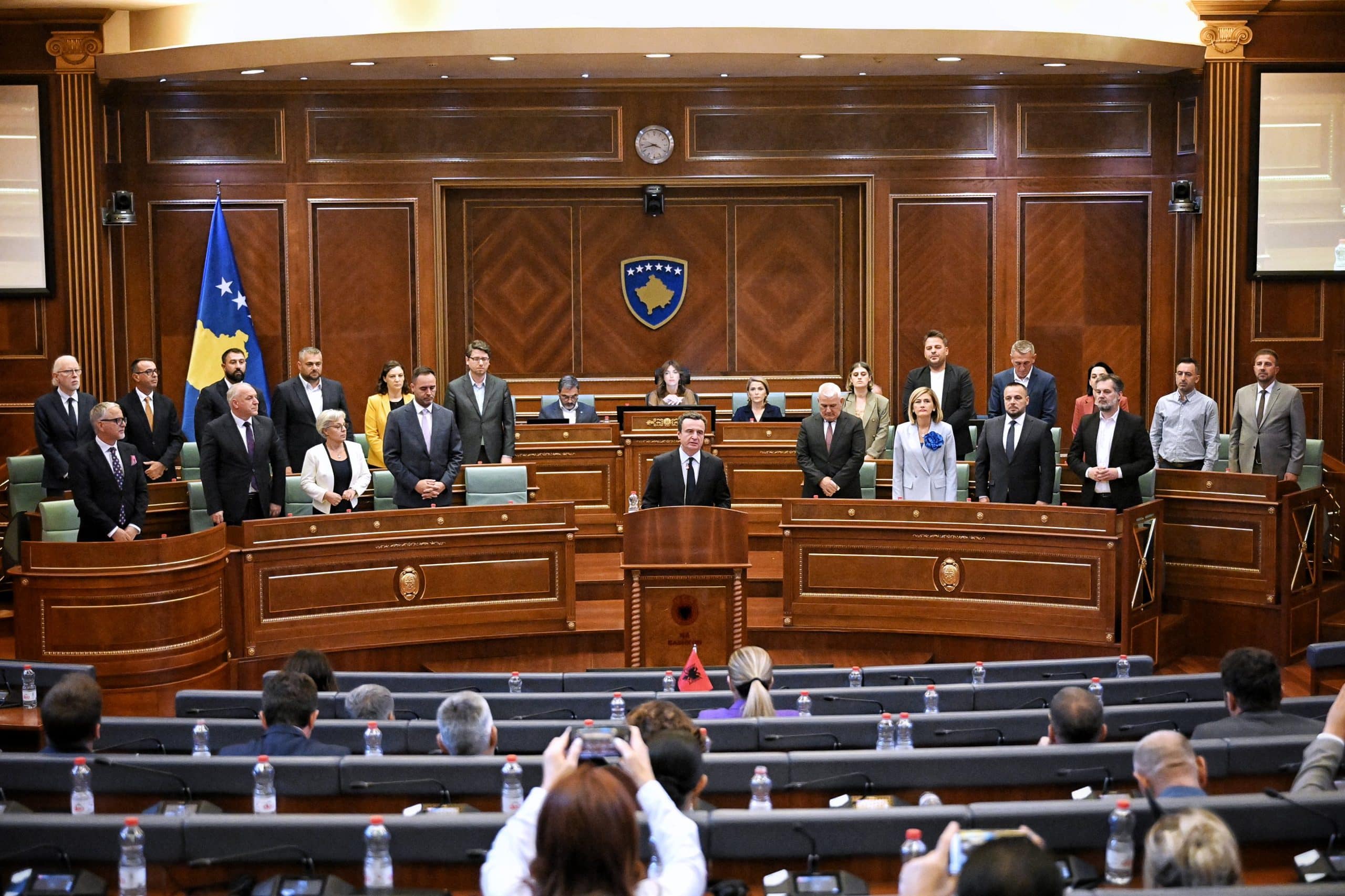
I will now present the next Government Cabinet, with all its portfolios: the executive emerging from this honourable 11th Legislature.
First Deputy Prime Minister and Minister of Foreign Affairs and Diaspora, Glauk Konjufca;
Second Deputy Prime Minister and Minister of Justice, Donika Gërvalla;
Third Deputy Prime Minister for Minority Affairs and Cooperation, Fikrim Damka;
Minister of Finance, Hekuran Murati;
Minister of Labour, Family and Liberation War Values, Andin Hoti;
Minister of Defence, Ejup Maqedonci;
Minister of Internal Affairs, Xhelal Sveçla;
Minister of Digitalisation and Public Administration, Lulëzon Jagxhiu;
Minister of Health, Arben Vitia;
Minister of Education and Science, Hajrulla Çeku;
Minister of Culture and Tourism, Saranda Bogujevci;
Minister of Local Government Administration, Elbert Krasniqi;
Minister of Sport and Youth, Blerim Gashani;
Minister of Environment and Spatial Planning, Fitore Pacolli;
Minister of Agriculture, Forestry and Rural Development, Armend Muja;
Minister of Infrastructure and Transport, Dimal Basha;
Minister of Industry, Entrepreneurship, Trade and Innovation, Mimoza Kusari;
Minister of Economy, Artane Rizvanolli;
Minister for Communities and Return, Nenad Rashiq;
Minister of Regional Development, Rasim Demiri.
Honourable Members of the Assembly,
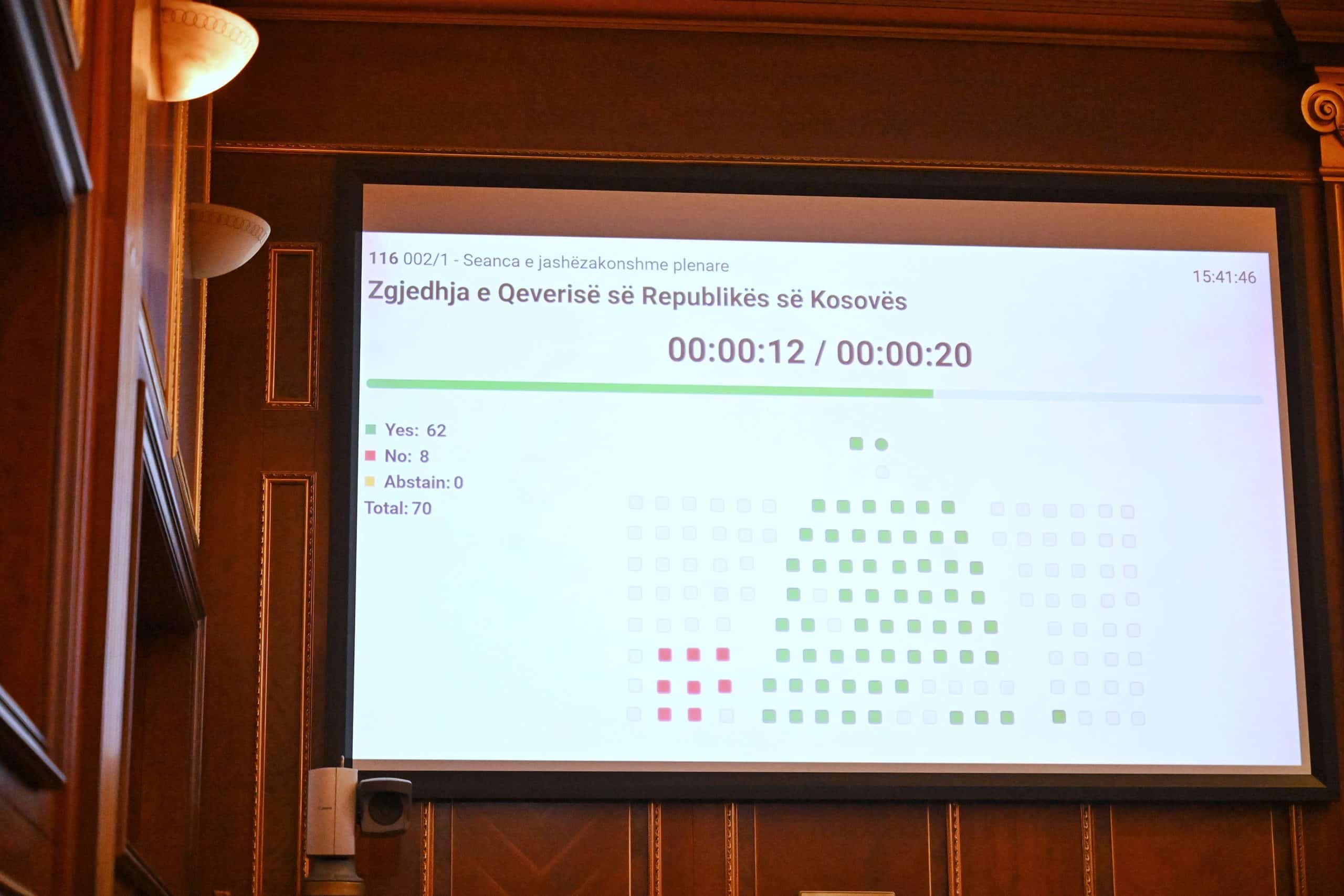
This is the next Government Cabinet, and these are our commitments for the new mandate. They are based on the work completed and the trust that citizens placed in us on 7 June. The Government we have proposed to you has a clear programme, defined measures and measurable responsibilities.
The citizens have given us a mandate to govern. It is for the Assembly to enable its implementation. It is also for the Assembly, through discussion and agreement, to find a solution for the election of the President. We will assume all the responsibility that belongs to us, and we expect the same from every parliamentary entity.
In October, we will submit the 2027 Budget. The mandate we seek from you is a mandate of justice and work, a mandate of dignity for each and every one of us and for all of us together without distinction, and a mandate of security and well-being for all.
Thank you very much for your support to date, for your attention and, in advance, for your support.
Thank you.