New York, 20 September 2026
Dear compatriots,
Good afternoon, everyone, and it is a pleasure to be here with you in the Bronx, New York,
Dear Mark,
Dear Drita,
Honourable Ambassador of the Republic of Kosovo to the United States of America in Washington, D.C., Ilir Dugolli,
Honourable Ambassador Blerim Reka, at the Mission to the United Nations here in New York,
I am here together with the Minister of Finance of the Republic of Kosovo, Hekuran Murati; the Deputy Minister of Foreign Affairs and Diaspora, Kreshnik Ahmeti; and three dear and special friends of mine: the Mayor of the Municipality of Presheva, Ardita Sinani; Member of Parliament Shaip Kamberi; and my adviser for Presheva, Medvegja and Bujanoc, Ragmi Mustafa.
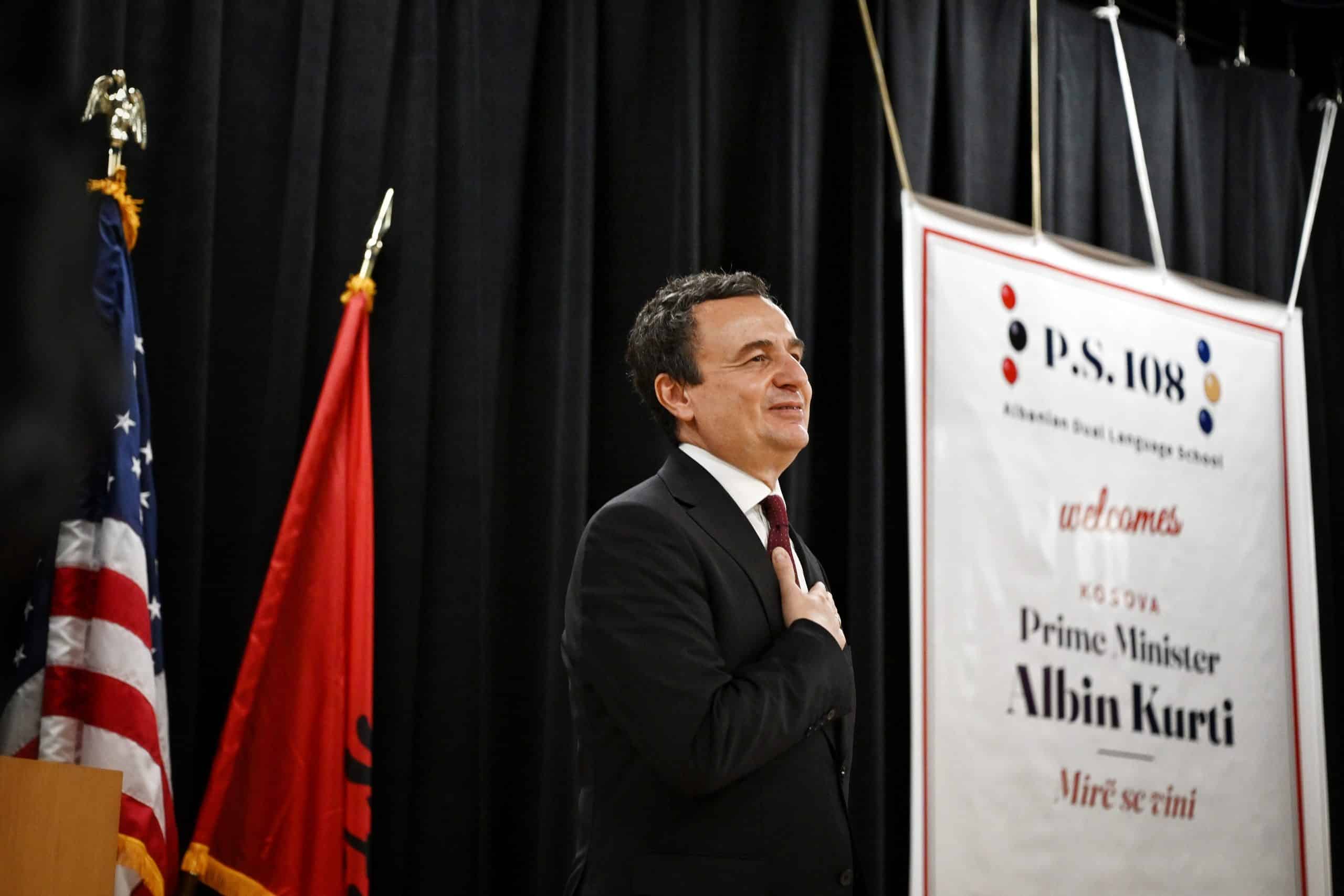
To the American officials with us today, I am very pleased to have joined you here and to have you in the audience. I apologise in advance for speaking Albanian, but in the spirit of bilingualism and of this school I will deliver half of my remarks in Albanian and half in English.
And as a gesture of good will I will be very happy to welcome you to Kosova, and I promise I will be a much better host than guest. Thought I should warn you: I don’t know anyone who came to Kosova and did not soon after return.
It is a special pleasure to be here today at the first institution outside Albanian lands where teaching takes place in both Albanian and English. Preserving our language has been one of our greatest achievements and one of our most powerful tools.
In our history, as in the history of many other peoples who have faced foreign occupation and rule, one of the instruments used to subjugate people has been precisely the banning of their language, or rather education in their language. Because language is not merely a means of communication. It is also a foundation of identity.
Language carries a people’s collective memory. It reflects the way in which, generation after generation, a people has learned to give shape to its own experience, the path by which it has understood itself and the world around it. It has been shaped over centuries by the experience of generations, by the effort to understand our reality, and also by confronting what others have tried to impose upon us.
A language that is extraordinary is also noble. What is special about Albanian is precisely its continuity. It is this distinctiveness, this nobility, that has been passed down from generation to generation. And thus, Albanian survived. It survived not only thanks to the high mountains, which often protected Albanians from invaders and external pressures, but above all thanks to people’s love for the language and their determination to pass it on to generations to come.
The language survived precisely by changing without losing its roots. Albanian absorbed influences from almost every major civilisation that ruled the Balkans, but retained enough of its grammar, strong syntax and inherited vocabulary to remain a distinct language with a rich vocabulary. Today it is one of only four such languages, each constituting an independent branch of the Indo-European family. Think of the Indo-European family trees, with their many branches of Germanic, Latin and Slavic languages. But there are four that stand as independent, albeit smaller, branches: Albanian, Greek, Armenian and Basque. Thus, there are these three large Germanic, Slavic and Latin families, as well as four branches, one of which is a distinct Indo-European branch: our beautiful Albanian language. This language has certainly been influenced from outside, but it has never been supplanted.
The Albanian language has remained alive even far from the homeland. The Arbëresh of Italy have preserved their language for more than five centuries. Their language itself tells us their story: it is a form of Albanian that carries within it their journey, their distance from the homeland and, at the same time, their deep roots in Albanian identity.
But it was not enough for our national revivalists simply for Albanian to survive. They wanted it to be a language of knowledge, high culture, profound scholarship and thought as well. In 1908, at the Congress of Manastir, Albanians united around a common alphabet. That same year, here in the United States, in Boston, Fan Noli celebrated the first liturgy in Albanian. Noli and our national revivalists in exile understood that without preserving the language, knowledge and culture, the nation itself could not be preserved. They showed us that the diaspora, our community abroad, is not merely a refuge far from the homeland, but a driving force of our thought, emancipation and state-building.
Today, Albanian is an official language of two states: Kosovo and Albania. This school continues the mission of the national revivalists here in America, where Noli began it in exile more than a century ago.
This school is a remarkable initiative for bilingual education in Albanian and English. For this, I wish to express my special gratitude to Mark Gjonaj and Drita Gjongecaj, as well as to all those who have worked over the past eight years to make this wonderful initiative a reality. The Government of the Republic of Kosovo is deeply grateful to you and will continue to support this school in the future.
My message to you, dear students, is this: language is not simply another means of communication, as though thought remained exactly the same regardless of the language in which it is expressed. When you speak your mother tongue, you do not merely convey your own thoughts. Your thinking connects with the heritage of the generations before you, the memory of the people and our collective dignity. By speaking, writing and thinking in this language, you also take part in creating its culture. In this way, you are more closely connected to your past, closer to yourselves and empowered to create the future.
It was also a special pleasure for me to be able to give workbooks, reading books and Albanian primers to the children, the pupils here, today. The principal, Ms. Mustafa, and the teacher, Ms. Gjongecaj, know better than any of us that children grow up between their mother and their teacher, not only through their mother and not only through their teacher, but through both. In a way, the mother is the first teacher and the teacher is the second mother. A child grows between care as love and teaching as knowledge. Between mother and teacher. Therefore, there is great joy in what you have accomplished over these years and great hope for the new successes you will achieve.
I will switch to English now. The program is only in its second year, so I will be lenient. But be warned: next year, when I come back for the UN General Assembly, your Albanian will be tested.
This school keeps our language alive far from home. In the same way, our diaspora has always kept Kosova alive far beyond its borders. Kosova grows within its borders, and at the same time it grows beyond them. Some of its most vital organs exist outside the country itself, in the communities of the diaspora.
The experience of Kosova and that of its diaspora have always mirrored one another. In the darkest periods of our history, we struggled at home, while our communities abroad faced struggles of their own: leaving home, putting down roots in unfamiliar places, and earning their place in societies that were new to them.
But we have entered a different chapter. Today, our story is no longer only one of endurance and survival. It is also one of confidence, achievement and possibility.
It is an extraordinary privilege to serve as Prime Minister of the Republic of Kosova at this moment. This year, Kosova turned eighteen. In one sense, we have only just reached adulthood. Yet this is also a moment where youth and maturity meet. We have enough experience to understand what we are capable of, enough achievements behind us to inspire confidence, and still enough ambition and energy to believe that much more is within reach.
I see the same in our diaspora. From where I stand, all that once seemed out of reach now feels is possible.
Members of our diaspora are at the forefront of robotics research and of breakthroughs in cardiology. They are building companies and helping to restore some of the most treasured historic buildings here in the United States. They sit in parliaments, in courtrooms and in the financial centers of the world. Their restaurants appear on The New York Times’ lists of the best in the country, and their films are recognized at the Cannes Film Festival. Our progress at home is echoed in their success abroad: here in the United States, in the United Kingdom, Germany, Switzerland, Austria, across Scandinavia and throughout the world.
They are creative, curious, hardworking, and willing to give back. As Jeronim De Rada, one of the great voices of the Albanian Renaissance, wrote: “Erdhi dita e Arbërit!”
This is our time.
The energy and achievements we see throughout our diaspora are reflected in the way we are building our country. Kosova shows the same resilience and the same determination to turn aspirations into reality. Kosova is a thriving democracy, and it has made significant progress across a number of international measures.
We have made major investments in our defense: in training, modernization and new equipment, while building domestic capacity, including the production of ammunition in Kosova.
Our technology sector is growing rapidly and already accounts for 6 percent of our GDP. For comparison agriculture is 7 percent of our GDP. We are pursuing an ambitious energy transition, investing in renewables while also seeking new ways to make use of our vast coal reserves. And we are investing in major infrastructure, including a new railway connecting us to Durrës, Albania’s largest seaport. With the segment that links Gjakova and Shkodra. As Albanians would have said, this segment is “zemreku i kombit shqiptar”.
Through all of this, we are building a society that is just and fair. This is not a time of binaries, of being either inside the country or outside of it, either here or there. It is a time of possibility, of greater choice, and of new ways of belonging. Just as the students of this school live in two languages at once, you can belong to two places at once. We are making space for you to help shape the next chapter of Kosova and our nation at large, wherever you live and however you choose to be part of it.
Thank you! Thank you very much!