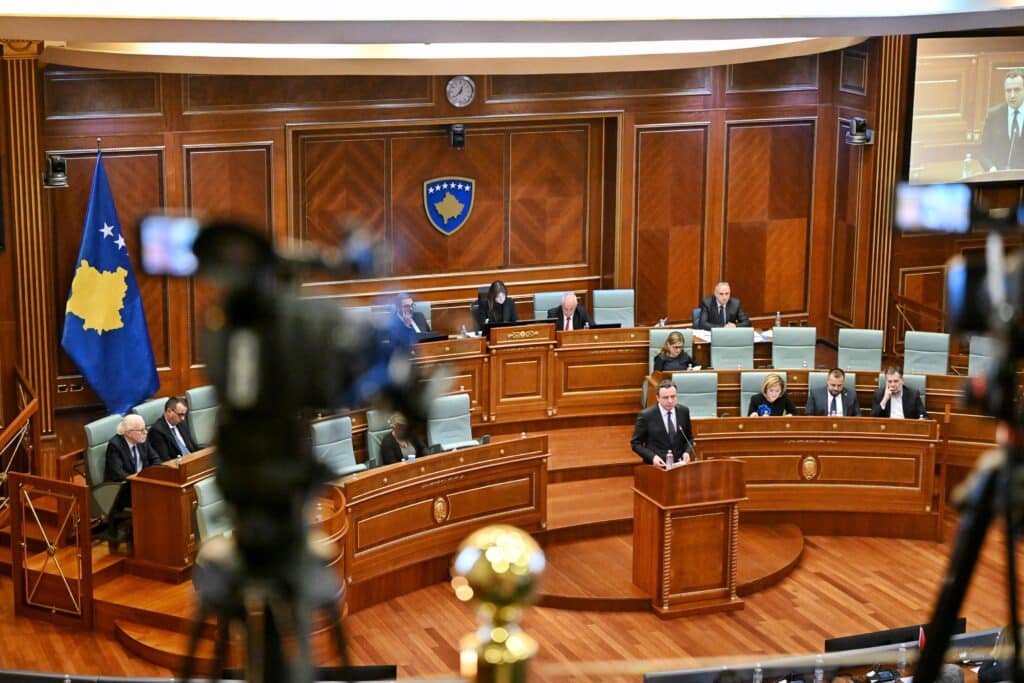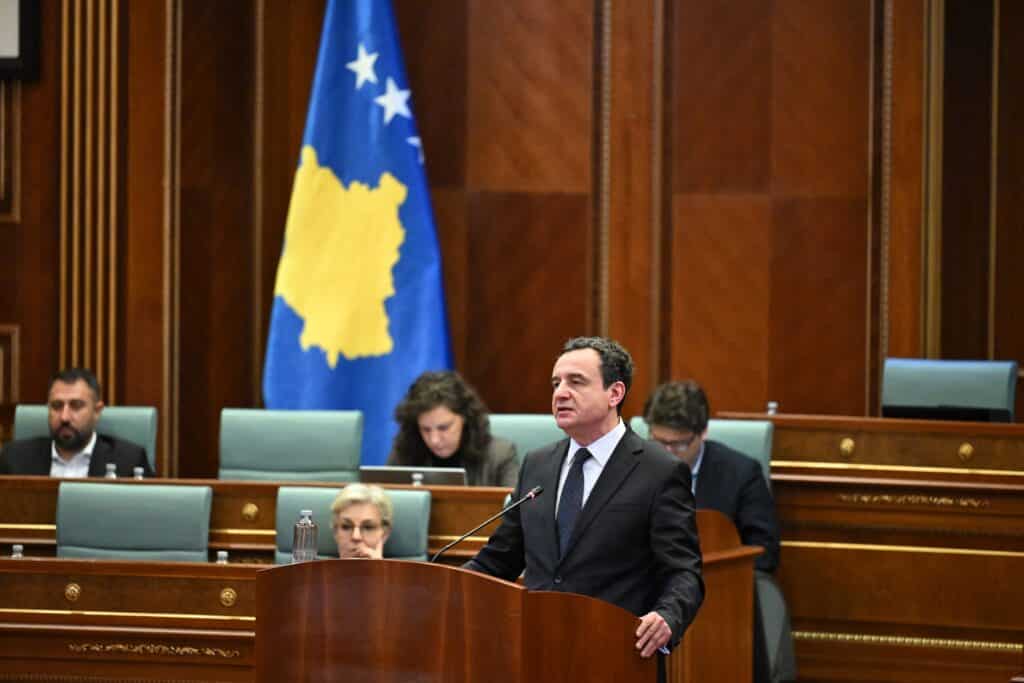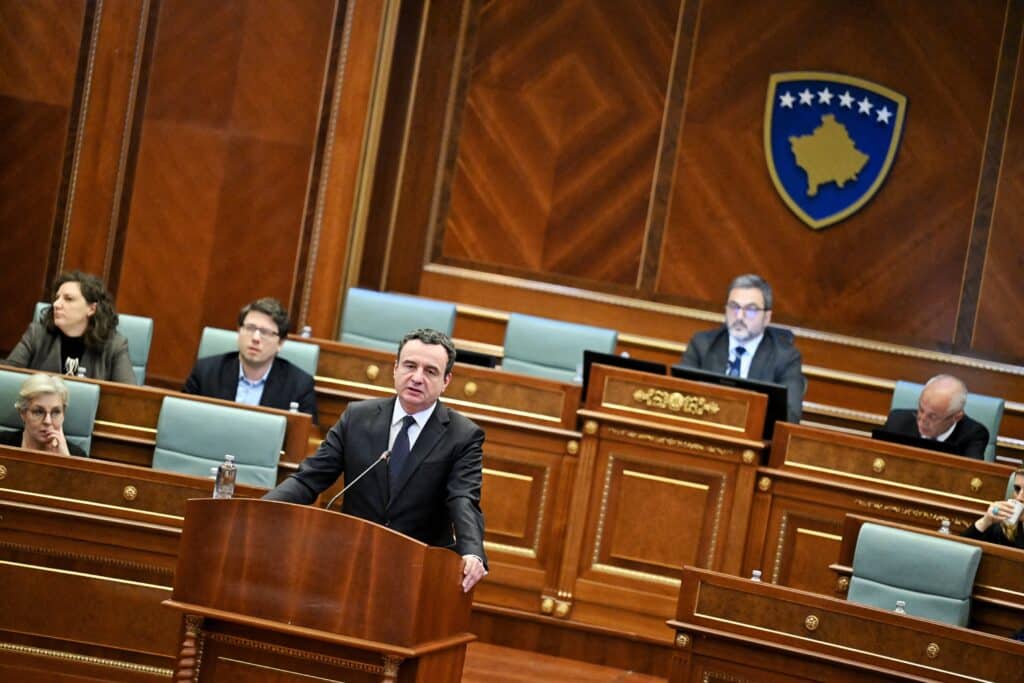
Prishtina, 2 April 2026
Full Speech of the Prime Minister of the Republic of Kosovo, Albin Kurti, at the plenary session of the Assembly of the Republic of Kosovo:
Honorable Deputy Speaker Gola,
Honorable Members of the Assembly,
Honorable Ministers of the Government,
Dear citizens of the Republic,
It is good to meet one another again in the plenary session of the Assembly of the Republic, upon the return of the house of democracy, almost one month after the President’s decree dissolving it. The decree issued was inconsistent with the Constitution of the Republic of Kosovo and has created a situation that requires clarity, not confusion; that requires responsibility, not evasion.
The Constitutional Court has spoken on the nature of our democratic and parliamentary republic and on the limits that the Constitution sets for each institution. In this order, the dissolution of the Assembly is not an instrument to overcome political difficulties and, above all, it has now been confirmed and demonstrated by the Constitutional Court that the President cannot dissolve the will of the people, neither under pressure of deadlines nor constitutional ambiguities. The will of the people is not annulled by decrees and, consequently, it cannot be dissolved.
Now, after the clarification and confirmation of this undeniable truth, today we do not have an institutional vacuum before us, but rather a clear task. The Assembly is functional and returns to its work. The mandate of the deputies is alive, and the responsibility toward processes and public policies is even greater. Constitutional deadlines are ongoing. The state has not ceased to function, and there is no reason for us to halt it.
On the contrary, any attempt to interrupt this functioning would not only be politically wrong, but also a precedent that undermines the very idea of the separation and balance of powers. Democracy is not sustained or advanced by blocking one another’s work and function, but by respecting each branch of power within the limits defined by the Constitution itself.
This is not an abstract issue or a theoretical debate. The continuation of the work of our institutions is more concrete than ever, and at the same time more necessary than ever before. Therefore, the path ahead of us should not be obstacles, resentments, or refusals to move forward, but what is expected from us is the approval of international agreements, a legislative agenda that improves the daily lives of citizens without distinction, and public policies that benefit future generations and require consistency and legal certainty.
All of this cannot be held hostage by a politically manufactured crisis. The will of the people was expressed on 28 December, in free and democratic elections; now we must speak about our will to advance good work for the citizens. Therefore, we must return to where we left off and continue our work with seriousness.
Citizens expect us to proceed as quickly as possible with the Bureau for the Confiscation of Unjustified Assets, because the fight against corruption is not a chapter that is opened and closed according to political need, but a continuous line that separates justice from injustice—something that citizens, regardless of party affiliation, demand and welcome. If citizens welcome it, there is no reason for parties not to support it.
We have not come here to manage a distorted reality; we are responsible for changing it positively. And change begins where the state makes it clear that every cent misused by public officials must be returned to its rightful owner—the citizen. If an ordinary citizen must account for every cent earned, then those who have become enriched unjustifiably must also answer for every euro they have abused.
We do not do this as an act of revenge, but as an act of equality. Because a state that does not punish the powerful who act unjustly, in fact abandons the weak every day. If we require taxes from everyone who works hard, whether physically or intellectually, and returns home exhausted every evening, then what reason is there not to demand accountability from those who, without effort, wake up enriched?
While we await support for the law on the Bureau—namely addressing abuses of public funds—we also expect support for protecting citizens from abuses with high prices. Both the ruling majority and the opposition are witnesses that our citizens have complaints about excessive prices. If we agree on the problem, we must also agree on the solution.
In other words, we must reintroduce the law on price caps, not as an ideological debate, but as a concrete response to a reality that every family feels daily. The world is moving from one crisis to another: one war begins and does not end, another begins that we never expected.
From the pandemic of 2020, to the war in Ukraine in 2022, and most recently the war in the Middle East, while the energy crisis of 2022 is now joined by that of 2026. You know that we have responded to each challenge with concrete economic packages, and in every dimension during the previous mandate we have tried to support every social category.
But, as in every crisis, you know, honorable deputies, that some choose to profit. There are traders and large businesses that have misused the crisis to artificially increase prices. Therefore, when the price of basic products rises beyond all economic logic, when the market loses its sense of fairness and the citizen remains unprotected, the state cannot hide behind abstract principles.
It must intervene with prudence, but also with determination. Because economic freedom cannot turn into the freedom to exploit, and the market cannot be a space where the stronger always prevails over the weaker.
It should be emphasized that we took this same initiative earlier, but it was challenged in the Constitutional Court by the opposition. Thus, complaints about high prices became a complaint to the Constitutional Court to prevent action against price abuses.
Now we will soon bring it back for a vote, and we expect the opposition to reflect and support us on this draft law. Because this draft law—new in form but essentially the same—protects all citizens from price abuses: those who support us as the majority, as well as those who support PDK, LDK, AAK, and others.
Therefore, shared problems require shared solutions, and we expect support from everyone. This is not an intervention against the market; it is an intervention for justice in the market. And justice in the market is part of justice in society.
Honorable deputies,
If the state must be fair in the economy, it must be equally fair in the public sphere. The public space belongs to everyone, which means it belongs to no one in particular. And here comes another issue that cannot be overlooked: the media.
A democracy does not live only from the citizen’s vote, but also from the spoken word—and that word must be free to be valuable. But the word cannot be free if it is captured by hidden interests. Reports of funding through bags of money are not merely a problem of professional ethics; they are a direct threat to the integrity of public debate.
Because when money enters invisibly, it does not only buy media space—it buys influence, shapes the narrative, and ultimately distorts citizens’ perceptions.
A misinformed citizen is not a free citizen. They are manipulated, and as reports indicate, this manipulation is coming directly from our adversaries, who unfortunately are also finding collaborators within our own country.
We have no interest in restricting the media. On the contrary, we want them to be stronger, more independent, more investigative, and more critical. But independence cannot be built on secrecy that finances slander and disinformation.
Editorial freedom must be guaranteed, but it must be accompanied by full transparency of ownership and financing. Citizens must know who is speaking, on whose behalf, with what resources, and who is financing them.
If every other business is accountable for its finances and sources, the media must also meet the same level of accountability. This protects citizens from manipulation and disinformation, but also protects honest journalists and media outlets that report with accurate sources and traceable funding.
The Law on the Independent Media Council that we will bring before you is not to control the media, but to protect it from capture. Censorship is the obstruction of truthful reporting, not the obstruction of false news with suspicious funding.
A democracy that fails to recognize this risk in time risks losing its freedom without realizing it; and with the same logic, the European Union has acted when it shut down Russian portals and television channels.
If in past dictatorships results were controlled, today there is a risk that oligarchies control the premises in order to manipulate the results. Today, interest groups do not touch freedom of expression directly; they control the economics of the media so that there is no need to interfere with expression itself.
Honorable deputies,
In the end, all these issues—from the decree to international agreements, from the fight against corruption to justice in the market and transparency in media—are connected by a single principle that must guide and unite us: the rule of law.
A state governed by the rule of law requires responsibility and accountability. We will continue our work so that our common republic becomes an example for all citizens without distinction and a model for the Western Balkans region.
Our people have suffered greatly from injustices imposed by others and therefore demand accountability and justice from their own representatives. The Assembly is the house where policies are advanced that demand accountability from those who have abused public funds, where standards for public discourse are set, where international agreements are supported, and where initiatives that protect citizens from price abuses are promoted.
This is the duty of all of us, and therefore it requires the support of everyone together.
These initiatives will very soon be before you, and we expect you to address, discuss, process, and adopt them as quickly as possible.
Therefore, today we do not have the luxury of delay. We do not have the luxury of blockade. And we do not need new, repeated elections as an escape from the responsibility that belongs to us.
Kosovo, its legitimate institutions, with a will clearly and recently expressed by the citizens, must be allowed to work. There have been enough elections and re-elections. Citizens have spoken enough.
Now we must work as much as possible, together, and not create new blockages that prevent the past year from remaining in the past.
Blockades, traps, loopholes, and tactics are not a mindset of development, but of stagnation. It is time to move forward and fulfill our duty, especially in these not easy global circumstances.
Thank you!