
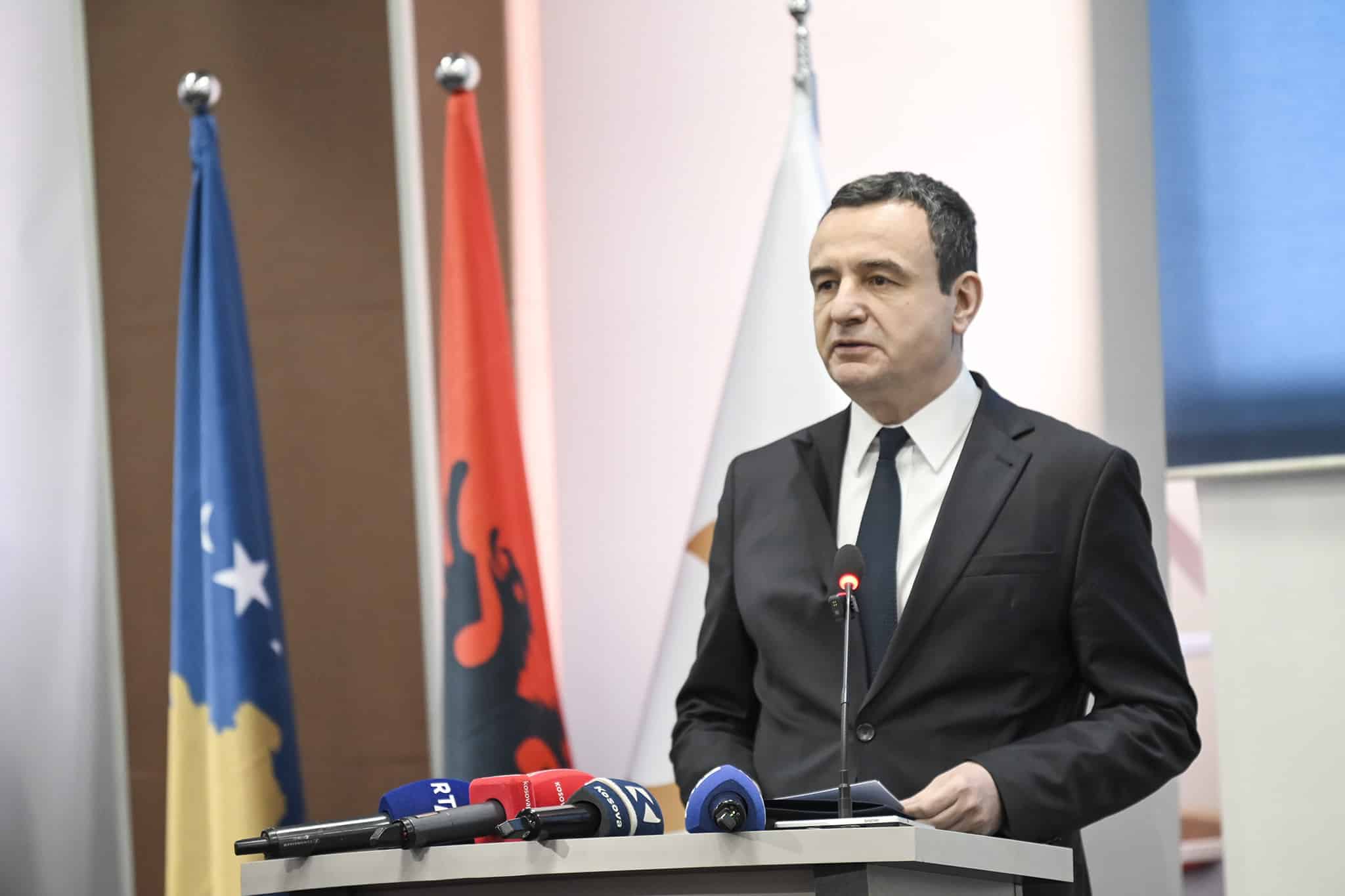
Prishtina, 10 December 2025
Honourable President of the Kosovo Academy of Sciences and Arts, Mr Mehmet Kraja,
Honourable President of the Republic of Kosovo, Ms Vjosa Osmani-Sadriu,
Honourable President of the Republic of Albania, Mr Bajram Begaj,
Honourable President Sejdiu,
Honourable Vice-President of the Federation of National Academies of Europe, Ms Marie Louise Nosch. The ASAK became a member of this Federation before Kosovo declared its independence, and for this we are eternally grateful,,
Honourable President of the Academy of Sciences of Albania, Mr Skender Gjinushi,
Honourable members of this academy,
Honourable international friends, leaders and representatives of the academies with which we cooperate and who are our guests today,
Honourable leaders and representatives of our various state institutions,
Ladies and gentlemen,
In the modern history of Albanians, both in Kosovo and in Albania, one of the greatest shortcomings from which our societies and our nation still have not managed to recover is precisely the failure to take part in the major debates of Modernity. This is because, especially in the 19th century, when our continent, Europe, was swept by the industrial and scientific revolution, our political fate was such that it kept us away from these epoch-making movements.
Nevertheless, from Helena Peshkopia, who on 25 June 1678 defended her doctoral thesis, becoming the first woman in the world with a doctorate in philosophy, and up to the erudite Sami Frasheri, who in the 19th century published the second encyclopedia in the world, among Albanians there have always been insular individuals, but also circles that have produced and circulated knowledge among themselves and with others.
This can be seen when you note that the National Library of Kosovo and other public and private libraries throughout Kosovo are filled with archival collections of manuscripts and various works from the Middle Ages onwards, gathered from all over our country. They were written by authors who, often, over the centuries, have remained anonymous among us. Mesihi of Prishtina, the renowned poet who once accompanied Michelangelo in Istanbul, has left us a pure poetic work, just as Pjeter Bogdani, through his letters, reports and works, has left us a host of prophetic voices about the time and the Albanian condition in the 17th century. Their list is long and the number of works written by them countless, as is their immeasurable volume, for the limited time available for this brief speech of mine on this occasion.
Honourable Academy, honourable academics,
On this jubilee anniversary, together with my most heartfelt congratulations on the 50th anniversary of the Kosovo Academy of Sciences and Arts, in the third decade of Kosovo’s freedom and the second decade of our Republic, starting from my position as Acting Prime Minister of the Republic of Kosovo as I speak from this lectern before you, allow me to recall an old and never-ending debate, that between politics and science.
From the founder of the academy, Plato, and his most distinguished student of science, Aristotle, the one author of the Republic and the other of Politics, the academy and politics have travelled together. Science and the arts, and power and the state, intertwine with one another between forums and battlefields, because scientific knowledge and art, being in public immanence, are always political.
The public sphere is the space where science and the arts are brought into view by being made public and where, from interpersonal relations with knowledge, with life, with nature and with society, people continually create and shape new worlds. Being conditioned in life by others like oneself, the human being is a political being, a being which, with its wonder at the world and its engagement to know itself and everything around it, becomes the condition of reality itself. And in the 1970s of the last century, precisely at the time when the ASAK was founded here, the structuralists and later the post-structuralists, especially the French ones, were addressing the relationship between scientific knowledge and narratives of truth, between philosophical thought and political power, as well as between art and authority.
Therefore, even today the three fundamental questions of the German idealist philosopher Immanuel Kant remain just as relevant: What can I know? What ought I to do? And what may I hope for? In the half-century history of the Kosovo Academy of Sciences and Arts, thousands of answers to these questions can be read, since in the history of the ASAK is also written the history of science and the arts in Kosovo, of thought and of action, ethical, aesthetic and political. Because, by the former and current members of this academy, hundreds of works and thousands of scientific, philosophical and artistic papers have been created and published, which have taken from and contributed to this country and the wider world, with the people of this society and towards other peoples.
The Kosovo Academy of Sciences and Arts is the highest institution, where there is no opinion that cannot be expressed, no hypothesis that cannot be advanced and no debate that cannot be held. Through this academy have passed all the ideas and elaborations of Kosovar society and of the Albanian nation, from the masterpieces of Albanian art to the ideas of the National Awakening figures about Albanianism, to aesthetic refusal and resistance in prisons, as well as the armed uprising for the liberation of Kosovo, that is, for the realization of the paradigm of freedom.
The period of the pandemic caused by the Corona virus, Covid-19, has shown us as rarely in history how important it is for a society to have scientists and professionals from all fields, skills and knowledge, scientific and artistic. Because, when peoples fall into crisis, their eyes and ears turn to their academies, and the home of all people and of all peoples is precisely the state, which is measured by its academy and the knowledge there, and it is and remains precisely the academies, universities and scientific institutes on which we depend much more than we imagine. And in our time, when hybrid wars, artificial intelligence and geopolitical tensions are on the rise, and when Western democracy and human rights are under attack as never before, academies must be busier than ever.
Therefore, support for your progress, Honourable academics, is more than an opportunity for us as politicians and state officials; it is an institutional responsibility, which intertwines with an obligation that is now always a historical one.
By preserving philosophical wonder and hypothetical doubt, by following curiosity, by cultivating research and developing study, in the hope for ever more science and knowledge, beauty and philosophy, let us join together in our congratulations on the second half-century of the Kosovo Academy of Sciences and Arts.
Congratulations to you all and thank you for your attention!