
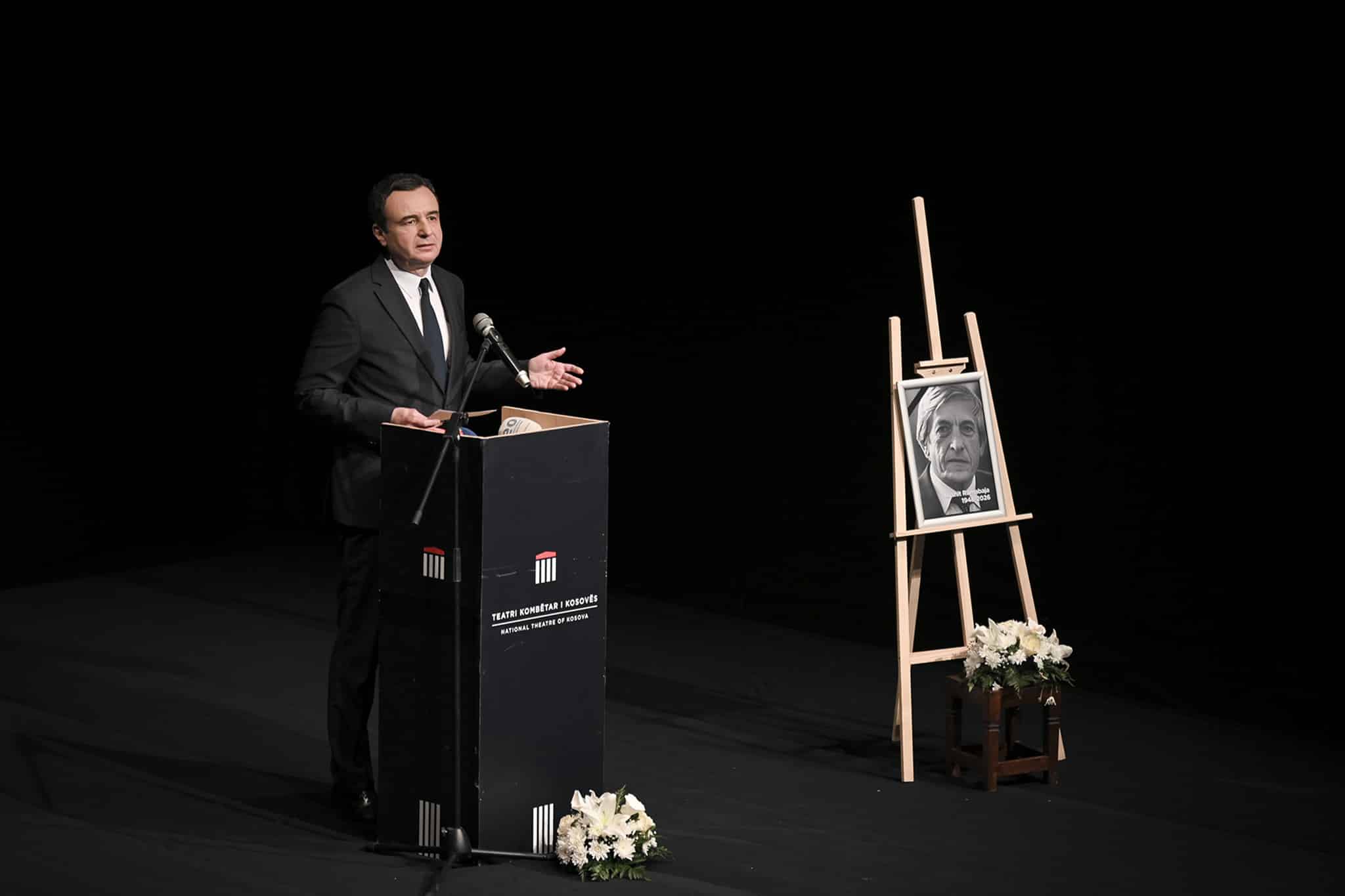
Prishtina, 4 January 2026
Esteemed Ramabaja family, dear friends, colleagues and associates, distinguished attendees.
We have gathered today to remember and honour a man whose words left a profound imprint on our culture and on our social and national conscience. The passing of Rushit Ramabaja at the age of 77 moves us deeply, because with him we lose not only a distinguished poet, journalist and publicist, but a rare intellectual voice that for decades remained loyal to the written word.
Rushit Ramabaja belonged to a generation of intellectuals shaped early and tested over time. Born in Marec near Prishtina, he devoted most of his life to journalism and literature, spending many years with the newspaper “Rilindja”, where cultural and critical expression carried both weight and responsibility. Even after the war, he continued to serve the public through radio journalism, never once departing from his mission of of informing and encouraging public reflection.
The passing of Rushit Ramabaja fills us with sorrow, because with him we lose a sensitive conscience and an engaged mind of our culture and our socio-political life. Rushit Ramabaja was among those intellectuals who did not see the written word as decoration, but as responsibility. He wrote not to be loud, but to be truthful.
In more than 20 literary works of poetry, prose and publicistic writing, we encounter the unease of a man who refuses to accept oblivion. We find the pain of history, but also the hope that the word can preserve what is in danger of being lost. His works bear witness to a life lived with critical thought, sensitivity and intellectual courage.
Rushit Ramabaja remained faithful to the words he wrote, even when they were difficult, even when they demanded confrontation. He was a model of the engaged intellectual, who did not retreat from reality, but confronted it with both mind and spirit. In every role he held, he was an active citizen, politically committed.
Today, at this commemorative ceremony, as Rushit Ramabaja departs from us in physical terms, we remember him not only for who he was, but for what he has left behind. He has left us books, ideas, memories, and a legacy that will continue to speak on his behalf. He has left us an example of how the word can serve simultaneously as a moral and a cultural act.
Even those who have written critiques of Rushit Ramabaja, om Radogoshi to Kadare, scribing him, for instance, as the Balzac of our times, are part of the collective memory we preserve of him, a memory that will endure for countless generations.
My most heartfelt condolences to the Ramabaja family,friends, colleagues, associates and those who knew and shared words with him, and undoubtedly loved Rushit.
From my own encounters with him, it was impossible not to hear from him something you would hear from no one else, and to witness a lucidity so rare, so clear and precise in grasping the essence of matters, whether political developments or historical analyses. In my view, uncle Rushit stood between history and beauty, between history as cause and beauty as purpose, and for that reason he remains personally unforgettable to me.
The sorrow of his family, of those of us who knew him, and of all his colleagues through the years is shared, as is the sense of loss now that he is no longer with us in the flesh. His words will continue to resonate, because they will be read, and because words arise from truth, which never dies.
May he rest in peace in the land of Kosovo.