
Prishtina, 31 March 2026
Dear Alidema family,
Dear Atdhe, Lendita, Yllka,
Dear Kryeziu family,
Dear fellow activists and friends of Halil Alidema,
Honourable Speaker of the Assembly of the Republic, Ms. Albulena Haxhiu,
Honourable ministers of our government, Andin Hoti, Saranda Bogujevci, Mimoza Kusari-Lila,
Honourable deputy ministers Mjeku, Krasniqi, Demelezi,
Distinguished Members of the Assembly of Kosovo,
Honourable Mr. Sherif Konjufca,
Honourable Mr. Vladimir Beja,
Honourable Mr. Durim Abdullahu from the University of Prishtina,
Ladies and gentlemen,
Honourable attendees,
Sisters and brothers,
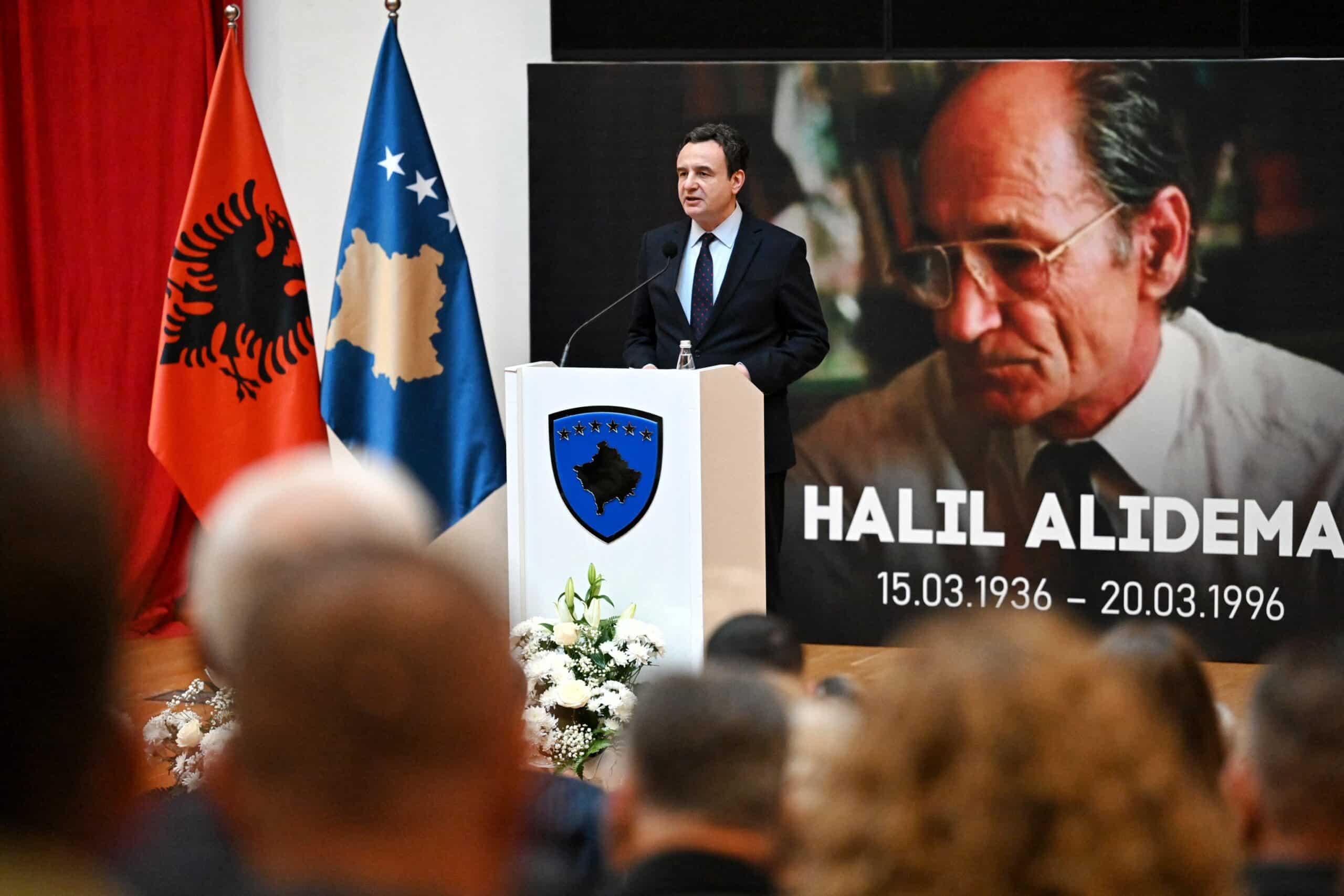
30 years after the death of Halil Alidema in 1996 in Tirana, we have all come together here today in Prishtina, family members, friends, colleagues and associates, to remember his personality and activity.
Addressing you from this lectern, it seems highly meaningful to me that Halil Alidema is being commemorated in the building of the “Ali Hadri” Institute of History, where part of the administration of the University of Prishtina is also located. This is because Halil Alidema himself was part of the administration of the University of Prishtina, as secretary at the Faculty of Philosophy, and because the historian Ali Hadri played an important role in the formation of Halil Alidema, encouraging him to study history.
And Halil Alidema not only studied history, but also made history, since he was politically engaged almost throughout his entire life, being one of the most important intellectuals and politicians in such a defining period for the history of Kosovo as that of the end of the 20th century, when the entire Albanian nation was striving to liberate Kosovo from Serb Yugoslavia.
Halil Alidema was born on 15 March 1936, and so this year he would have turned 90 years old. This means that he could still have been among us, as some of his comrades still are, some of whom we also have here in the hall today. But he died early, at the age of 60, moreover in circumstances suspicious with regard to his illness and which have remained unexplained ever since.
At that time, he could hardly have imagined that within the time span of his own generation, the ideal of Kosovo as a Republic, for which Halil Alidema and his comrades were imprisoned in 1981 and suffered in the prisons of Yugoslavia, would be realised through the creation and state-building of the Republic of Kosovo. Therefore today, I have the pleasure, as Prime Minister of the Republic, that republic for which Halil Alidema himself was also committed, to address you at this commemorative academy dedicated to him.
But whom are we commemorating today, and more precisely, why? Who was Halil Alidema and what does his figure represent for Kosovo, for its people and for its state?
In the long history of the battles of the Albanians left under Yugoslavia, the battles of the war for liberation and state-building, Halil Alidema stands out as one of the distinguished and most important figures. Anyone seeking to understand the social developments and political movements in Kosovo, especially during the 1980s and 1990s, will find Halil Alidema’s name, alongside his comrades, almost everywhere that Albanians’ political aspirations for freedom and national unification were being pursued.
Also being by character a highly active man, Halil Alidema was imprisoned several times by the Yugoslav authorities, beginning as early as his youth, then again in 1968 when, after the student demonstrations, he was sentenced to two years’ imprisonment. But his willingness to assume political responsibility for the demonstrations of 1981 placed Halil Alidema at the head of a group of intellectuals who were arrested and tried, being sentenced to long and heavy terms of imprisonment. Among them were also Professor Ukshin Hoti, Ekrem Kryeziu, Mentor Kaci, Shemsi Recica, Ali Kryeziu, Hilmi Ratkoceri, etc. Halili was sentenced to 11 years in prison, of which he served more than six years.
The harsh prison experience, the torture and the damage to his health did not weaken Halil Alidema’s resolve to continue his political engagement even after his release from prison. He remained equally determined and very clear in his political path and that of the other political prisoners, as is also understood from his words given to the newspaper “Dielli” on 5 June 1991, in an interview with journalist Islam Spahiu, in which Halil Alidema had said:
“Political prisoners never failed, neither during imprisonment nor after imprisonment. Their high national consciousness, their sense of responsibility and sacrifice has made most of them quite tolerant, flexible and highly communicative. They were the bearers and spokesmen of the national resistance. They are and will remain the most exposed sacrifice in defence of the national cause. We were not, we are not and we will not be prisoners of ideological exclusivity, but together with every compatriot we commit ourselves to reconciliation and national liberation. Bearing this spirit in mind, our principle is: HOMELAND ABOVE ALL!”.
Halil Alidema gave this statement exactly one month after the founding of the Party of National Unity – PNU, which he would go on to lead as its chairman until his death. The name of the PNU is closely linked with the name of Halil Alidema, who through this party articulated the idea of national unification already in the party’s very name, but also in its programme.
From Prishtina to Skopje and from Skopje to Tirana, Halil Alidema spread his political organisation and activism across the three main centres of the Albanians. At that time, he focused his engagement on organising armed resistance in Kosovo, by sending a large number of groups of volunteers from Kosovo and Macedonia, who went to be trained by the Albanian army in Albania. Most of these volunteers later became members and fighters of the Kosovo Liberation Army in 1998 and 1999.
Halil Alidema died on 19 March 1996, without living to witness the liberation war, the liberation of Kosovo, the declaration of independence, and the building and progress of the country of Kosovo. But all of these together are also the result of his engagement with his comrades, of the organisations and of his generation. Therefore, today we remember and honour him among his comrades and his legacy.
Family members, friends and fellow activists, and researchers, will speak today about particular aspects of Halil Alidema’s political and patriotic activity, but for me as Prime Minister of the Republic of Kosovo and for the institutions of our independent state, the political work of Halil Alidema will remain a clear and strong point of reference for the ideals and examples upon which our country has been built and continues to develop.
May the life and work of Halil Alidema be remembered through the generations as it is being remembered now, forever!
Thank you!