Prishtina, 2 April 2026
Honorable Speaker of the Assembly of Kosovo, Ms. Albulena Haxhiu,
Honorable Deputy Prime Minister and Minister of Foreign Affairs and Diaspora, Donika Gërvalla,
Honorable Minister of Culture and Tourism, Saranda Bogujevci,
Honorable Deputy Commander of the Kosovo Security Force, Major General Enver Cikaqi, and other members of our armed forces,
Honorable former Prime Minister of Kosovo, Bajram Kosumi,
Honorable Chairman of the Association of Former Political Prisoners, Shefik Sadiku,
Honorable Mayor of the Municipality of Shtime, Qemajl Aliu, and of the Municipality of Kamenica-Dardana, Kadri Rahimaj,
Honorable Ms. Elmije Plakiqi,
Honorable Hydajet Hyseni,
Honorable participants and contributors to the demonstrations of 1981,
Honorable professors and students,
Honorable Members of the Assembly, colleagues from the Government, deputy ministers,
Honorable attendees,
Ladies and gentlemen,
Sisters and brothers,
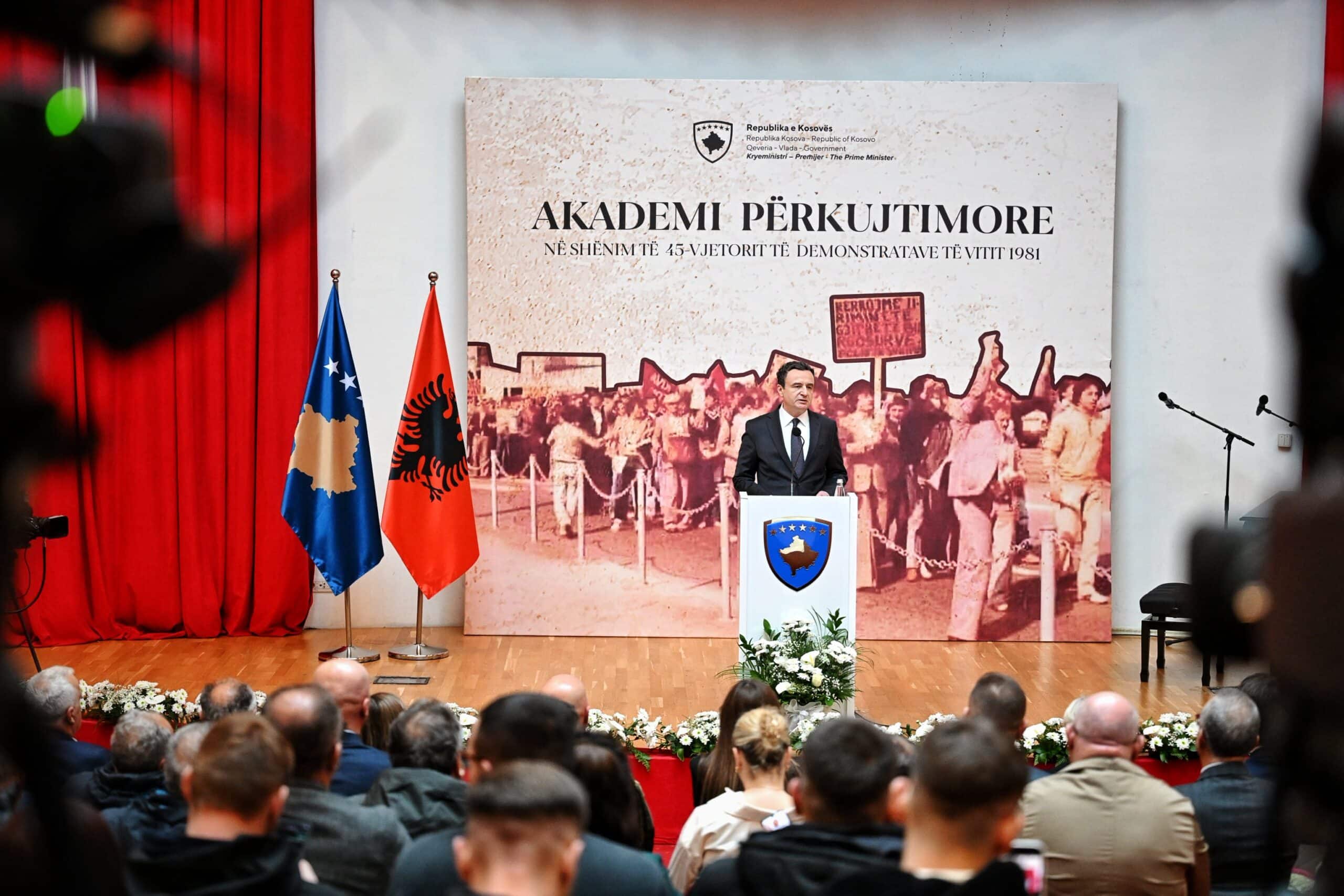
For years, and especially during the period of freedom, every spring we have commemorated the demonstrations of March and April 1981 in Kosovo as a turning point—a threshold placed beneath a heavy door that closed one era and opened another. This year, on the 45th anniversary of the 1981 demonstrations, I am very pleased to see you all gathered here to share memories and reflect on the events that gave rise to them.
As the head of our Government, I have the special pleasure of hosting this commemorative academy, as this gathering has been organized by the Office of the Prime Minister of the Republic of Kosovo—the very republic and Kosovo that were so powerfully proclaimed and written about during the demonstrations of 1981.
The acronym “KR,” as the initials of the slogan “Kosova Republic,” encapsulates the political ideals of several generations of Albanians in Kosovo, Albanians in Yugoslavia, and the Albanian nation as a whole. Consequently, the demand for the Republic of Kosovo—this call—remains one of the most politically charged markers in the philosophy and history of modern Albanian political thought.
Being here among so many activists who were organizers, participants, witnesses, and inheritors of the 1981 demonstrations, it is not for me to recount those events, as they are lived experiences embedded in your memory. Moreover, after me, Bajram Kosumi will speak, who through his book “Revolucioni 1981” (Revolution 1981) has skillfully elevated political memoir literature of that period to the level of scientific study. However, by outlining a chronology of the developments of spring 1981, allow me to emphasize the political legacy of those demonstrations.
At that time, half a century ago, Albanians in Yugoslavia were the most oppressed and politically marginalized people, as well as the most discriminated against and economically exploited on ethnic grounds. They were deprived of many cultural and social rights and treated as second-class citizens, as a population to be eventually expelled from their native lands through ethnic cleansing, to create more space for Greater Serbia. The accumulated indignation over the years erupted that year, articulated politically in a mass movement.
The demonstrations began on 4 March 1981 as a revolt over student cafeteria conditions, evolving into a protest on 11 March after the Prishtina–Partizani football match. Two weeks later, on 26 March, it became a nationwide demonstration during the “Youth Relay” event. Slogans such as “Kosova Republic,” “We are Albanians, not Yugoslavs,” and “Unification with Albania” shook Yugoslavia. The brutal intervention of the Yugoslav police did not weaken the civic will.
On 1 and 2 April 1981, the demonstrations reached their peak, spreading across Kosovo. During those days and after, police violence resulted in nine deaths, fifteen wounded, and thousands arrested and imprisoned, facing politically motivated trials. During and after these popular, peaceful, and just demonstrations, Serbian police killed: Asllan Pireva, Afrim Abazi, Naser Hajrizi, Ruzhdi Hyseni, Sherif Frangu, Ibrahim Krasniqi, Xhelal Maliqi, Salih Abazi, and Riza Matoshi.
After the demonstrations of 1981, Kosovo was transformed into a society where everyday life was marked by persecution and political trials, arrests, torture, imprisonment, ‘informative talks’ within security structures; political isolation and discrimination; constitutional and status-related changes; disregard for and suppression of political will, accompanied by coercion; as well as states of emergency and conditions of martial law. These developments turned Kosovo into a vast open prison, in which more than one-third (1/3) of its citizens went through arbitrary practices of the police, investigative authorities, prosecution, secret services, and prisons. Over 80 percent of political prisoners in Yugoslavia during the 1980s were Albanians.
Yet 1981 set Kosovo on a path toward fulfilling its political aspirations. The ideals of those demonstrations inspired the political movements of the 1990s, from peaceful resistance to armed struggle led by the Kosovo Liberation Army. Many organizers and participants carried this resistance forward, and their signatures appear on the Declaration of Independence of 17 February 2008—symbols of those enduring ideals. But never forgetting that we place emphasis on what has not yet been achieved, not only on what we have just accomplished. Here, there is a particularly distinctive signature on the document of the Declaration of Independence of 17 February 2008—the signature of Hydajet Hyseni, which is preceded by four very special marks: three dots and a comma, and then the name Hydajet Hyseni. Thus, independence was declared not simply as a final destination, but rather as a station we reached in order not to stop.
The demonstrations of 1981 are thus embedded in the foundations of our state and in our ongoing commitment to progress. Kosovo’s history will preserve them as a distinct chapter, while collective and institutional memory will honor their martyrs, organizers, and participants.
Honoring those killed and wounded in the 1981 demonstrations, as well as all activists of that generation, in honoring the fallen and the steadfast fighters for the liberation of Kosovo and the freedom of its people, I thank you for your attention and participation.