
Dear Acting President of the Republic of Kosovo, Ms. Albulena Haxhiu,
Dear colleagues from the Government, Minister of Justice Donika Gërvalla, Minister of Labour, Family and Liberation War Values, Andin Hoti, Minister of Culture and Tourism Saranda Bogujevci, Chairman of the Association of Former Political Prisoners Mr. Shefik Sadiku,
Dear former MPs, representatives and heads of state institutions,
Dear former political prisoners under Serbia’s occupation,
Dear invalids and veterans of the Kosovo Liberation Army,
Dear survivors of the Dubrava massacre,
Dear families of those killed and survived in the Dubrava massacre,
Dear families of martyrs of the nation,
Distinguished attendees, ladies and gentlemen, brothers and sisters,
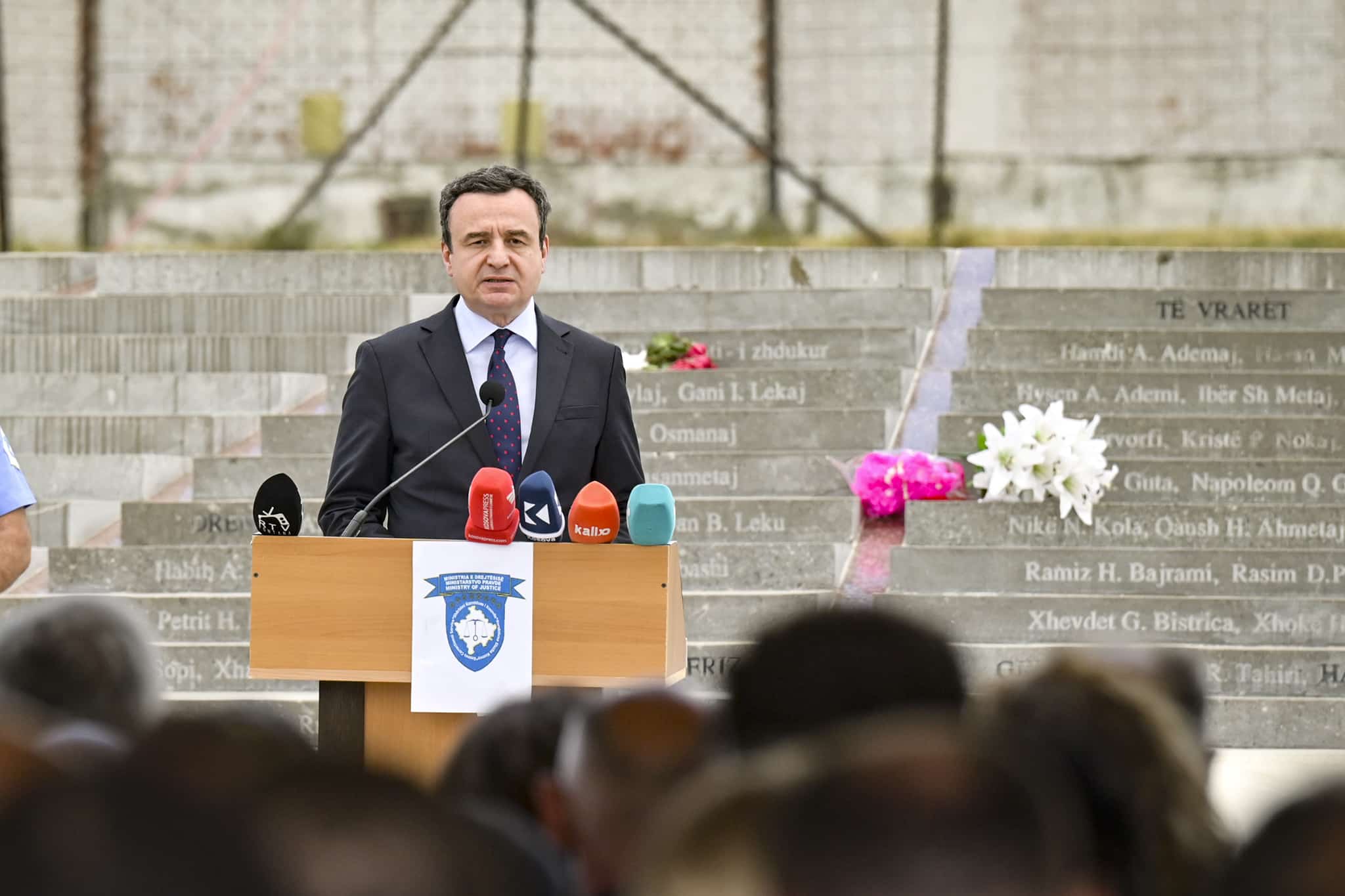
Today we are gathered here with respect, pain, and historical and national responsibility to remember one of the deepest wounds of the war in Kosovo: the Dubrava Massacre. We stand here today facing a part of the history of our Republic, a history written with unwavering resistance and sacrifice for freedom.
At the end of April and beginning of May 1999, Serbian authorities transferred Albanian political prisoners from various prisons to Dubrava. This mass concentration of prisoners in a single location occurred precisely at the time when Milošević’s regime was implementing its genocidal plan in Kosovo. Dubrava was part of the state repression mechanisms used against Kosovo Albanians and, during the war, was turned into a firing ground.
In contemporary studies of memory and violence, prisons of the regime are considered spaces of political control and production of collective fear. Prisons in the former Yugoslavia, especially those in Serbia during the 1980s and 1990s, were systematically used against Albanian political activists, students, and intellectuals. For this reason, the history of Dubrava is directly linked to the broader history of the political imprisonment of Albanians in the former Yugoslavia.
In those days of May 1999, within Dubrava Prison, the criminal state of Serbia committed one of the most inhumane acts. Out of approximately 980 Albanian prisoners, 116 were killed, 185 were wounded, while the professor and political thinker Ukshin Hoti was forcibly disappeared. Political prisoners and Albanian civilians were brutally killed in violation of all international laws. This was a crime against humanity, a flagrant violation of the Geneva Conventions and every norm of human civilization. The names of the Dubrava victims, engraved on the memorial, constitute a permanent indictment against those who ordered, organized, and executed this crime.
Dubrava remains evidence of mass and genocidal executions of Albanians, of torture and mistreatment of Albanian prisoners, but also of the freedom-loving spirit of political prisoners who did not break or surrender under torture in Serbian prisons.
The testimonies of those days are harrowing, but so are the heroic acts of prisoners who helped their fellow inmates. The organized efforts among prisoners for protection, medical aid, and food remain a testament to courage. Above all, even the living standing in the same yard with their murdered comrades is a haunting image of endurance.
Therefore, today, as we remember the victims of this massacre, we also honor its witnesses: those who survived, those who testified, those who wrote books, gave evidence, and preserved the truth from oblivion. Their testimony is part of Kosovo’s historical truth and collective memory. The Republic of Kosovo has a moral and state obligation to preserve this memory, document the truth, and seek justice for all victims. Because a state that protects memory enables justice and builds peace.
Therefore, beyond being pain, our memory becomes direction. It becomes a moral compass for future generations, so that freedom is never taken for granted and the crimes of the past are never allowed to repeat themselves.
Distinguished attendees,
Today, as we remember the martyrs of Dubrava and the way they were killed, we also remember the reason they lived: for freedom, for the right of our people to live free in their own land and to decide for themselves.
The Republic of Kosovo today is a sovereign, independent, and democratic state. We have stable institutions, an army that protects our territory and constitutional order, and a youth that studies, works, and dreams in freedom. This free Kosovo is the legacy of the fallen, the martyrs, the freedom fighters, political prisoners, and all those who sacrificed and contributed so that we may live free today.
Eternal memory to those killed here in Dubrava Prison.
Deep gratitude and long life to all survivors of this massacre.
Glory to the fallen on Kosovo’s long and difficult path to freedom!
Thank you!