
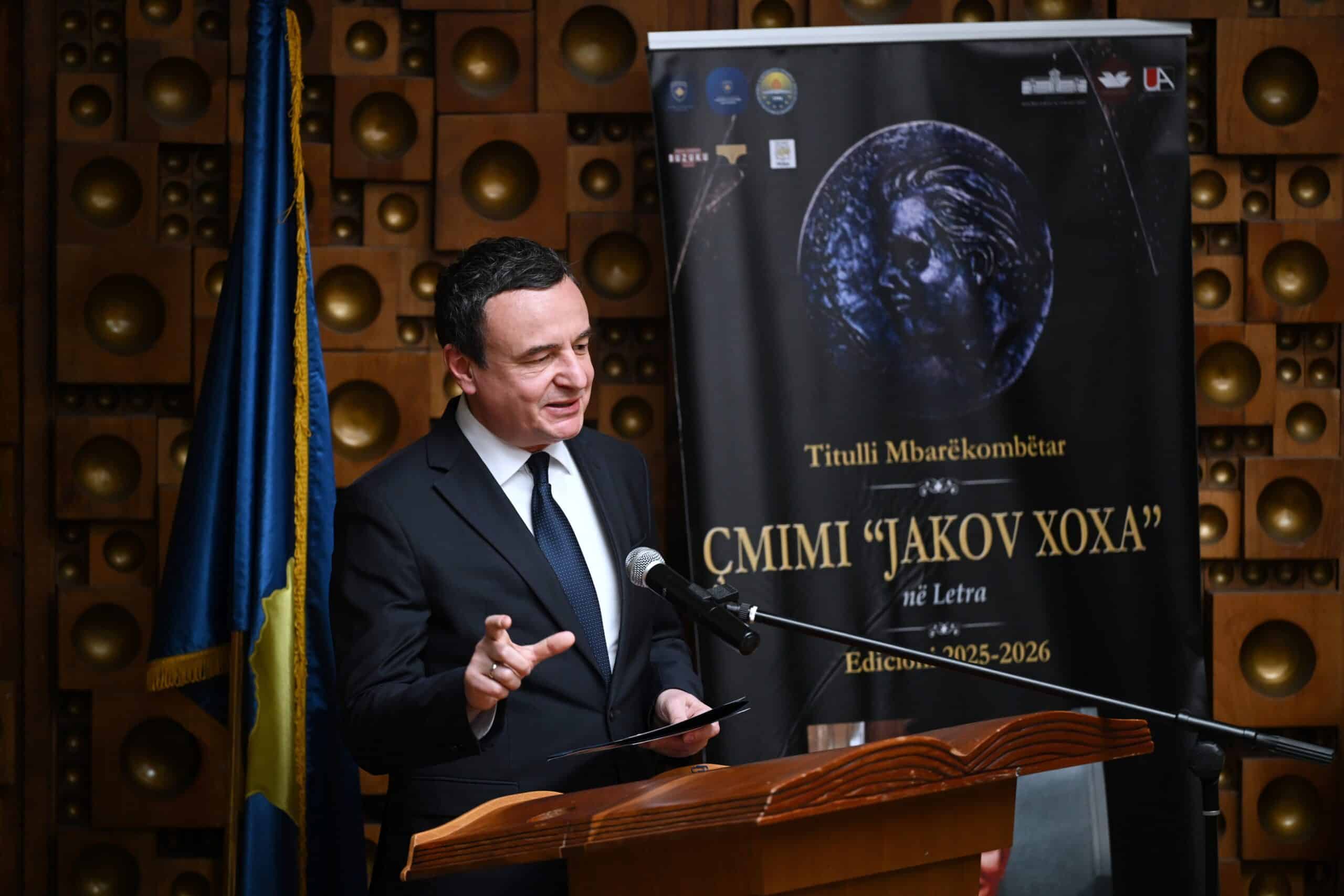
Prishtina, 19 May 2026
Honourable Ms. Saranda Bogujevci, Minister of Culture and Tourism,
Honourable Abdullah and Edon Zeneli, publishers,
Honourable Mr. Agron Jakov Xoxa,
Honourable Ms. Valentina Leskaj,
Honourable Academician Ali Aliu,
Honourable Professor Shefkije Islamaj,
Honourable Ms. Arta Marku, Director of the National Book and Reading Centre,
Honourable participants, guests, lovers of books and culture,
Ladies and gentlemen,
Today, when thought is constantly interrupted and concentration has become one of the most fragile things of our time, literature remains one of the rare forms that resists the disintegration of attention. It does not function according to the logic of immediacy. It is not produced for instant consumption, nor does it depend on the speed at which things circulate. Precisely for this reason, it continues to remain fundamental. Not because it is nostalgia for a bygone world, but because it is one of the fullest ways to better understand what interests us most.
And although life is far too short compared to the greatness of all that has been written, literature nevertheless manages to create an irreplaceable relationship with time. Whenever we stand before it, we are not merely in contact with a text, but with the human and intellectual experience accumulated over centuries. It is among the few spaces where time does not disappear, but is always preserved.
It enters our lives early and remains for a long time, indeed forever, as part of the very way thought and experience are formed. Today we think differently precisely because we read literature. Even today, when technology seems to dominate everything, often at the expense of literature itself, and when it is transforming the way information is produced, imagination still remains the original source of every creation. Every great vision has first passed through language. Writers understood this long ago, and before anyone else.
Albanian literature too has fulfilled this function in an extraordinary way. It has not only been the bearer of cultural identity, but also an expansion of the Albanian language itself as an instrument of thought and knowledge. In many authors, language does not merely serve to tell a story; it becomes a way to convey an entire worldview emerging from a village, a neighborhood, an era, or an individual. One of the writers who powerfully achieves this is precisely Jakov Xoxa.
Not only through the way he uses words, but also through their number and abundance, he transformed Albanian into a linguistic force. His lexical richness is not a stylistic ornament. It is a profound knowledge of life and labour, and a love for language itself as the primary register of knowledge. To employ so many units of the Albanian language, so many emotional states, nuances of character, and rhythms of speech, requires an extraordinary observation of human beings and their reality. His literary universe is not built upon abstractions, but upon the concrete density of Albanian life, upon the memory of generations, upon human relationships, and upon the way history enters individual destiny.
It is precisely here that the greatness of Lumi i Vdekur (The Dead River) lies. The title itself is a powerful reversal of meaning: the river, as a symbol of movement and life, is declared dead, while the language describing it remains extraordinarily alive. This is why the novel still carries weight today, decades after its first publication in 1961. Not only because it belongs to the history of Albanian literature, but because it still succeeds in generating meaning.
And now, in our home libraries, countless people possess Lumi i Vdekur (The Dead River) and then Lulja e Kripës (The Salt Flower), books that one after another have become standards in our libraries. But if love today is as it is because of the nineteenth-century novel, then lovers in Kosovo are, to a certain extent, also as they are because of the love between Adili and Vita, which was the love story of Lumi i Vdekur (The Dead River). It made love more alive than any river, while at the same time breaking this Albanian-Albanian border that unjustly separated us because of conferences in which we had not participated and because of wars that amounted to genocide against us.
Therefore, Lumi i Vdekur in particular carries great political weight for the Albanian nation and it is essential that it be studied where literature and history intersect—not only literature in relation to the Albanian language, but also literature in relation to the history of the Albanian people.
The importance of literature in general, and of Jakov Xoxa himself, therefore lies not only in what it narrates, but also in its ability to expand the horizon of human thought. He gives language the capacity to hold more reality, more memory, and more consciousness.
Great works inspire great projects.
Thank you for the invitation, your attention, and for the excellent work you are doing.