Prishtina, 9 March 2026
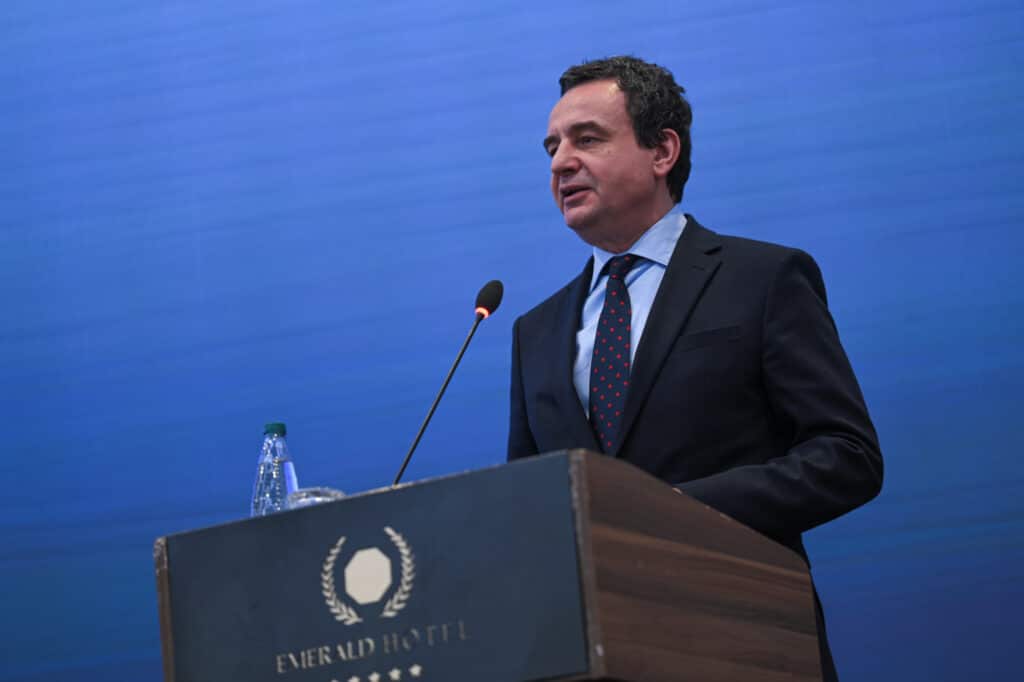
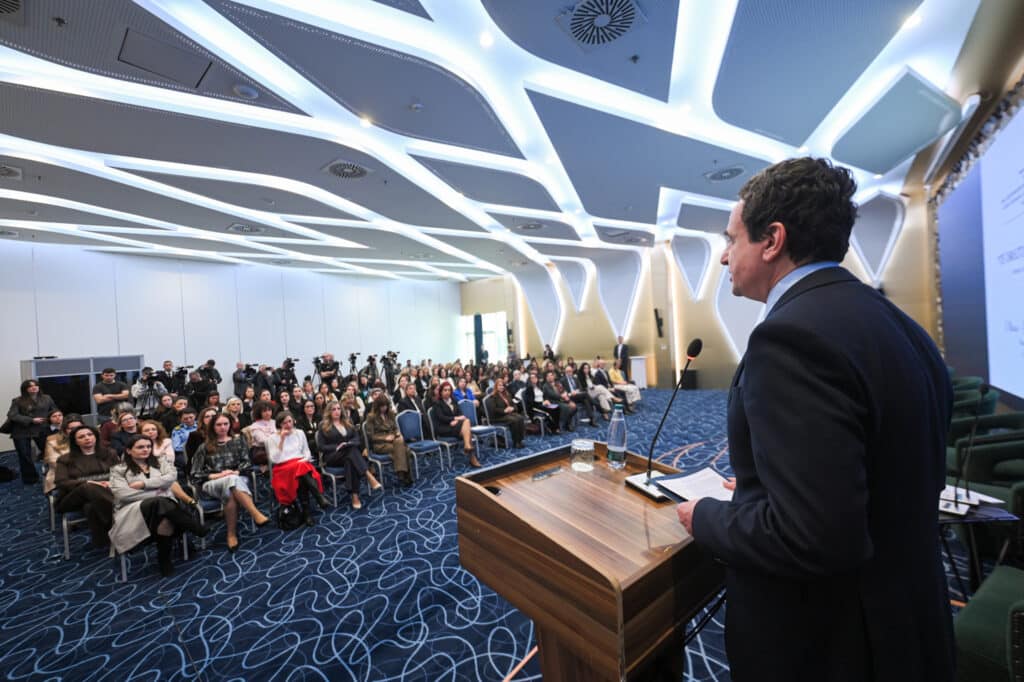
The Prime Minister of the Republic of Kosovo, Albin Kurti, participated in the marking of International Women’s Day, under this year’s global theme: “Rights, Justice, Action,” organized by the Agency for Gender Equality (Kosovo) within the Office of the Prime Minister of the Republic of Kosovo.
On this occasion, Prime Minister Kurti stated that during the Government’s mandate, the empowerment of women and girls has been a concrete priority, supported by policies, budget allocations, and measurable results.
Full Speech by Prime Minister Kurti:
Honorable Ms. Albulena Haxhiu, Speaker of the Assembly of the Republic of Kosovo,
Honorable Ms. Edi Gusia, Executive Director of the Agency for Gender Equality,
Honorable Ms. Emilija Rexhepi, Deputy Speaker of the Assembly of Kosovo,
Honorable Ms. Eva Palatova, Deputy Head of the EU Office in Kosovo,
Honorable Ms. Fatmire Kollçaku-Mulhaxha, Chairperson of the Committee on Human Rights, Gender Equality, Labour, Family, Values of the Liberation War and Petitions,
Honorable representatives of institutions from our country and the region,
Honorable women, activists of civil society organizations in our country,
Honorable international partners,
Distinguished participants,
Ladies and gentlemen,
On International Women’s Day, we speak about equal justice not as an abstract principle, but as a responsibility of the Republic of Kosovo.
Equal justice in Kosovo means that the rights guaranteed by the Constitution and the law are fully implemented in every court, every workplace, every municipality and every police station. It means that domestic violence and discrimination are neither tolerated, justified nor concealed, but prosecuted and prevented. It means that every girl and woman in Kosovo has equal access to education and quality opportunities for life and career.
Equal justice means that women are not only voters, but also decision-makers. It means equal representation in politics, leadership, public institutions and meaningful participation in shaping the future of our country. Because a democracy cannot be strong if half of its population is underrepresented.
It means zero tolerance for gender-based violence. Not only declarations, but implemented protection orders, perpetrators held accountable, survivors supported through accessible legal aid, shelters and economic opportunities.
It means labour laws that guarantee equal pay for equal work, healthcare that respects women’s dignity, a Family Law that protects equality, and justice institutions free from prejudice and influence. Equal justice is not only a women’s issue; it is a measure of our democracy, our European path and our future.
In other words, the rights written on paper must be implemented in practice.
During our mandate, the empowerment of women and girls has been a concrete priority, supported by policies, budgets and measurable results.
We have directly supported the employment of over 12,000 women. Through the Superpuna platform, more than half of newly employed persons are women, while 55% of beneficiaries of the “Government for Families” program are also women. Thousands of girls have benefited from internships, scholarships in STEM — Science, Technology, Engineering and Mathematics — and support for entrepreneurship, agriculture and export-oriented businesses.
We have financially supported mothers and children: around 80,000 new mothers have received allowances; over 400,000 children benefit from child allowances, which are issued in the name of the mother; and around 100,000 women have opened bank accounts for the first time as a result. We are also increasing women’s access to property — from only 105 properties registered in the names of both spouses in 2016, a decade later there are over 31,000 such registrations.
We launched an employment measure for women who are victims of violence: the Government subsidizes 70% the salary of employed women for six consecutive months.
We increased the number of female correctional officers employed in the Correctional Service: 83 women during the period March 2021 – December 2025, compared to only 16 during the period 2018–2021. We supported 711 businesses — 30% of them owned by women — with export potential through grants worth €20.5 million, as well as subsidizing investment loans for 378 businesses, of which 57 were women-owned; and €11 million for 5,655 women farmers in agriculture through subsidies and grants.
In healthcare, we have increased the budget by 57%. Free mammography is now available throughout the year, HPV vaccines are provided, new MRI machines have been added and more than 70 medicines have been included in the essential medicines list. Early detection of breast cancer is now a reality.
We are investing in childcare infrastructure: 73 new kindergartens, compulsory early childhood education and a voucher program for families receiving social assistance — because women’s economic activation is directly linked to childcare.
We have increased women’s representation in public administration and decision-making: 63% of newly employed civil servants in 2024 are women; representation in boards and independent institutions is at a record level. In the Kosovo Security Force and the Kosovo Police, the number of women is steadily increasing. Most recently, my Chief of Staff is Flora Macula, a well-known civil society activist who has also served in various institutional positions defending and advancing women’s rights.
We have strengthened mechanisms against domestic violence: a National Strategy, a protocol for handling cases of sexual violence, free legal aid for victims, wage subsidies for women victims of violence, and €7.3 million in support for shelters.
In public enterprises we have introduced meritocracy and equality — 50% of appointed board members are women. Two large public enterprises now led by women have moved from deep losses to profit and clean audits.
These are not merely statistics, distinguished participants. They are concrete steps toward the economic, social and political equality of women in Kosovo.
Equality is not a promise — it is work, decision-making and budget. And this work continues.
Thank you for the invitation and for your attention.